
There is a corner in my backyard that I ignored for three full years. Two fence lines meet there at a slightly awkward angle, the grass never grew properly in that spot, and every time I looked at it I thought — I’ll figure that out later. Later kept not coming.
When I finally stopped walking past it and actually stood in that corner for a few minutes, I noticed something I had missed entirely. The two fences created a natural enclosure. It was already three-quarters of a room. All it needed was someone to treat it like one.
That realization changed how I think about backyard design entirely. The corners are not the problem areas. They are the opportunities that most people keep deferring. This guide covers thirteen ways to approach them — from simple planting solutions to full structural installations — with honest notes on what actually works and what just looks good in photos.
— Written from experience designing and redesigning outdoor spaces, including that corner I ignored for far too long 🌿
1 • Why Backyard Corners Go Unused — And Why That’s Worth Fixing
The neglected backyard corner is one of those universal experiences that nobody really talks about. You have it. Your neighbors have it. It sits there year after year collecting leaves and mild guilt, and the reason it stays that way is not actually about budget or time — it is about perception.
Most homeowners look at a corner and see a problem: an awkward shape, uneven grass, a spot where furniture does not fit. Landscape designers look at the same corner and see something completely different. They see two existing walls. They see a natural boundary that someone has already built for free. They see a space that is three-quarters enclosed and just waiting for someone to close the fourth side with intention.
The enclosed quality of a corner is actually its greatest asset. Open backyards can feel exposed and hard to settle into. A corner, properly designed, feels sheltered. It creates the psychological comfort of having something behind you — the same reason people prefer booths over open tables at restaurants, the same reason we gravitate toward the edges of rooms at parties.
Why Corners Are Better Than You Think
- Two fence lines create natural enclosure — you already have three walls
- The enclosed feeling creates psychological comfort that open spaces lack
- Corners are separate from the main yard — easier to design as a distinct space
- Improvements here have outsized visual impact because the contrast with neglect is so high
2 • Treating Corners as Outdoor Rooms — The Mindset Shift That Changes Everything
The single most useful thing you can do before touching your backyard corner is to stop thinking of it as leftover space and start thinking of it as a room. Not metaphorically — literally. Indoor rooms have walls, a defined purpose, a floor treatment, and furniture arranged to support that purpose. Outdoor corners can have all of the same things.
The fences are your walls. A paving treatment, gravel, decking, or even a defined planting bed is your floor. The furniture or planting arrangement is your layout. The only thing missing in most neglected corners is a clear decision about what the room is for.
That decision comes first. Is this a place to sit quietly in the morning? A cooking and entertaining space? A garden feature to look at from the house? A hammock corner for afternoon naps? Each of these requires a completely different approach, and trying to do all of them at once usually results in none of them working. Choose one purpose, commit to it, and let every subsequent decision serve that purpose.
“The most neglected corner of your yard is usually three-quarters of a room already. Someone just needs to finish it.”
3 • Pergola Lounges That Frame the Space Properly
A pergola is probably the most transformative thing you can add to a backyard corner, and the reason is simple: it adds the one element that fence lines cannot provide on their own. A ceiling. Or at least the suggestion of one.
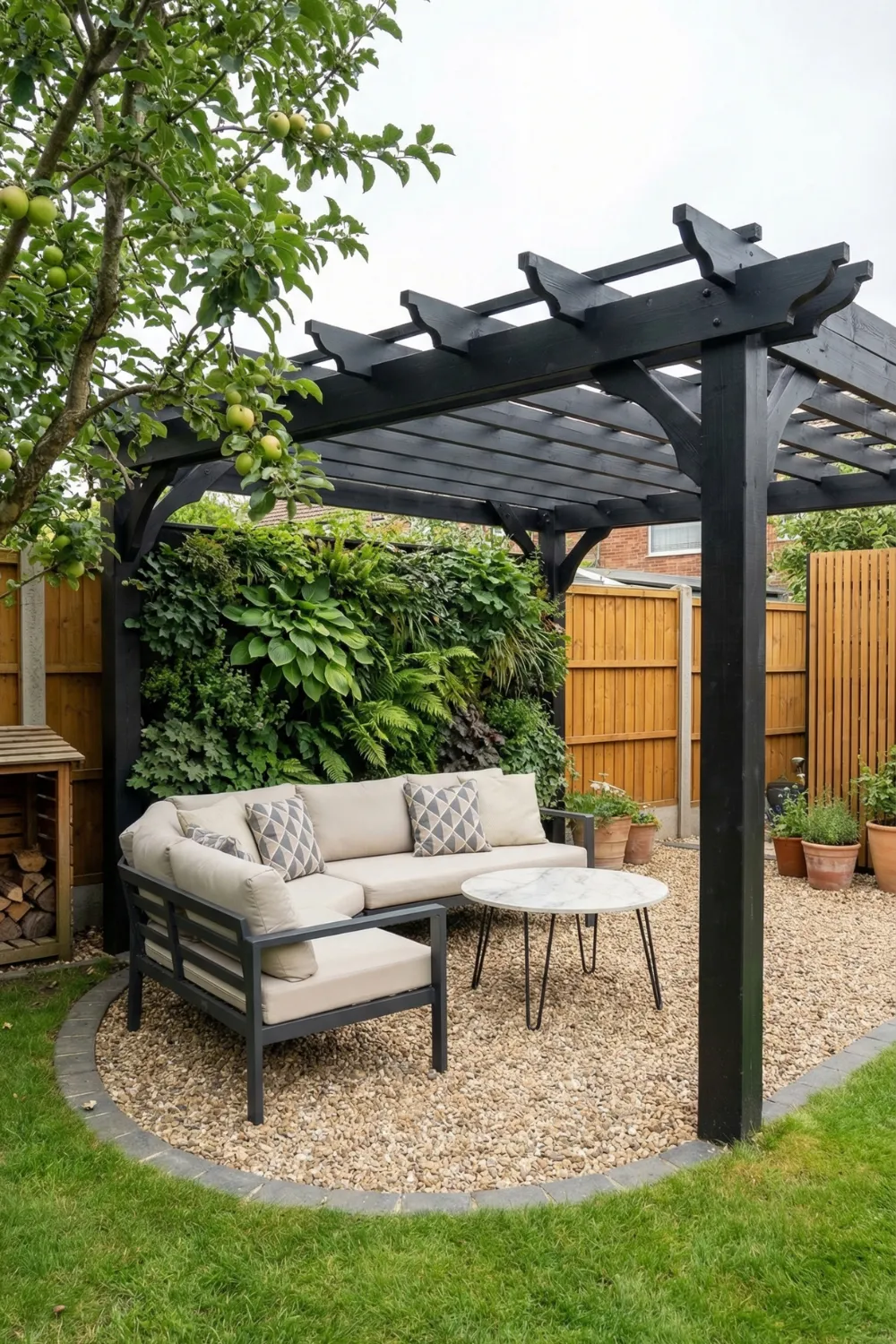
When you place a pergola in a corner, the structure uses the two fence lines as its back walls and creates a sheltered zone that feels genuinely distinct from the rest of the yard. The overhead beams define the space from above. Anyone sitting beneath them immediately feels like they are somewhere — inside something — rather than just outdoors in a general sense.
Climbing plants amplify everything. A pergola with bare beams looks structured. The same pergola with jasmine, wisteria, or climbing roses working their way across it looks like it has been there for decades. Round furniture softens the sharp angle of the corner junction. Add gravel or stone underfoot to define the zone and improve drainage, and the corner stops being a problem area and becomes the destination.
4 • Compact Outdoor Kitchens That Use the Corner Shape to Their Advantage
Here is something that kitchen designers have known for decades and outdoor living designers have slowly adopted: the L-shaped layout is the most efficient working configuration possible. A backyard corner is essentially a pre-built L-shape waiting to be used.
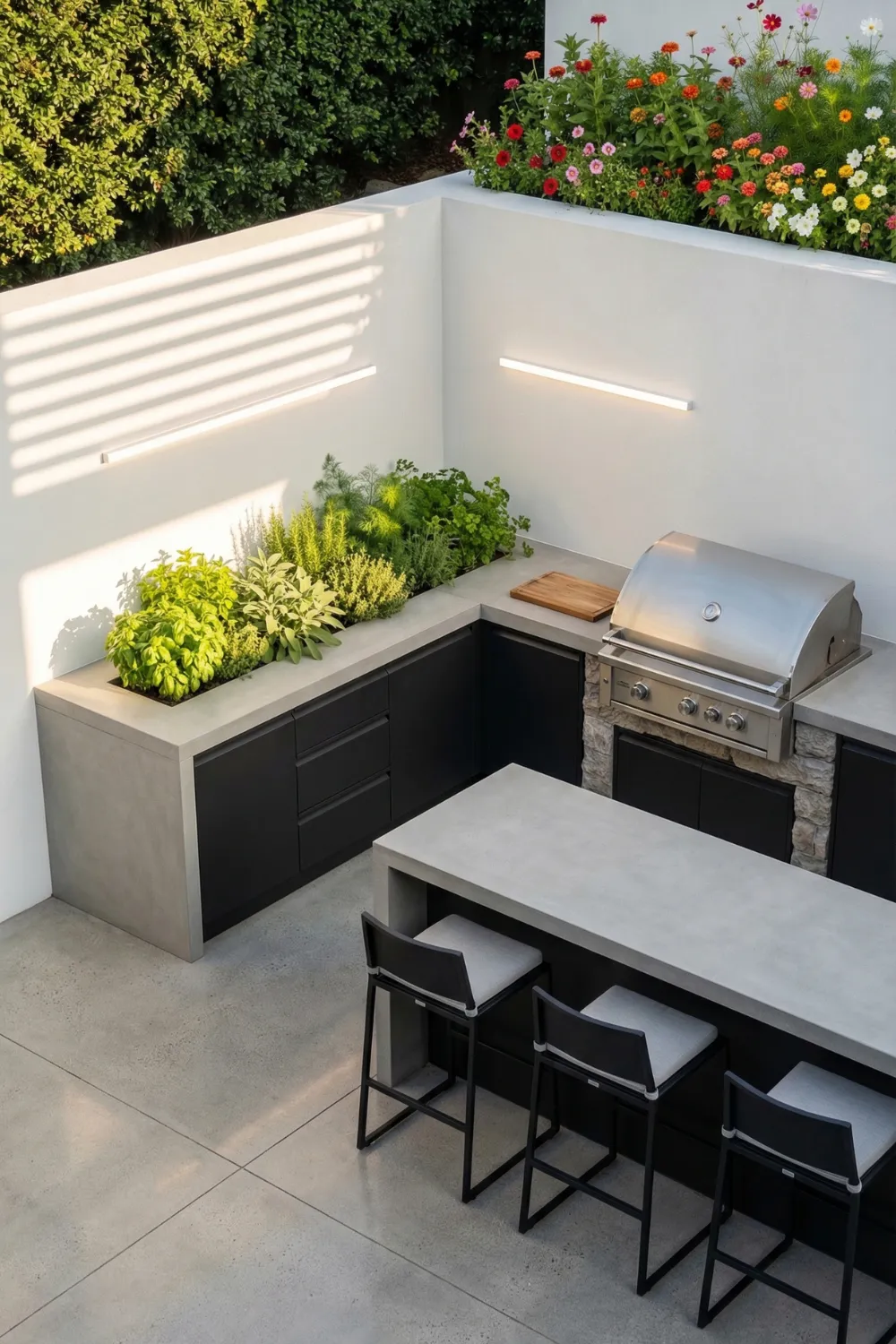
Installing an outdoor kitchen in a corner means the fence lines do the structural work. Counters and cabinets can run along both fence faces, meeting at the corner junction and creating a continuous working surface. The cook faces outward toward guests rather than being tucked away against a single wall. It is a fundamentally social layout.
Light countertops hide less but clean easily. Dark cabinetry handles weathering and staining more gracefully. A small planter of herbs mounted on the fence nearby adds green, keeps fresh ingredients close, and signals that this space is cared for. Seating along the outer edge creates the natural separation between cooking zone and social zone that makes outdoor kitchens genuinely functional.
5 • Fire Pit Corners That Become the Heart of the Yard
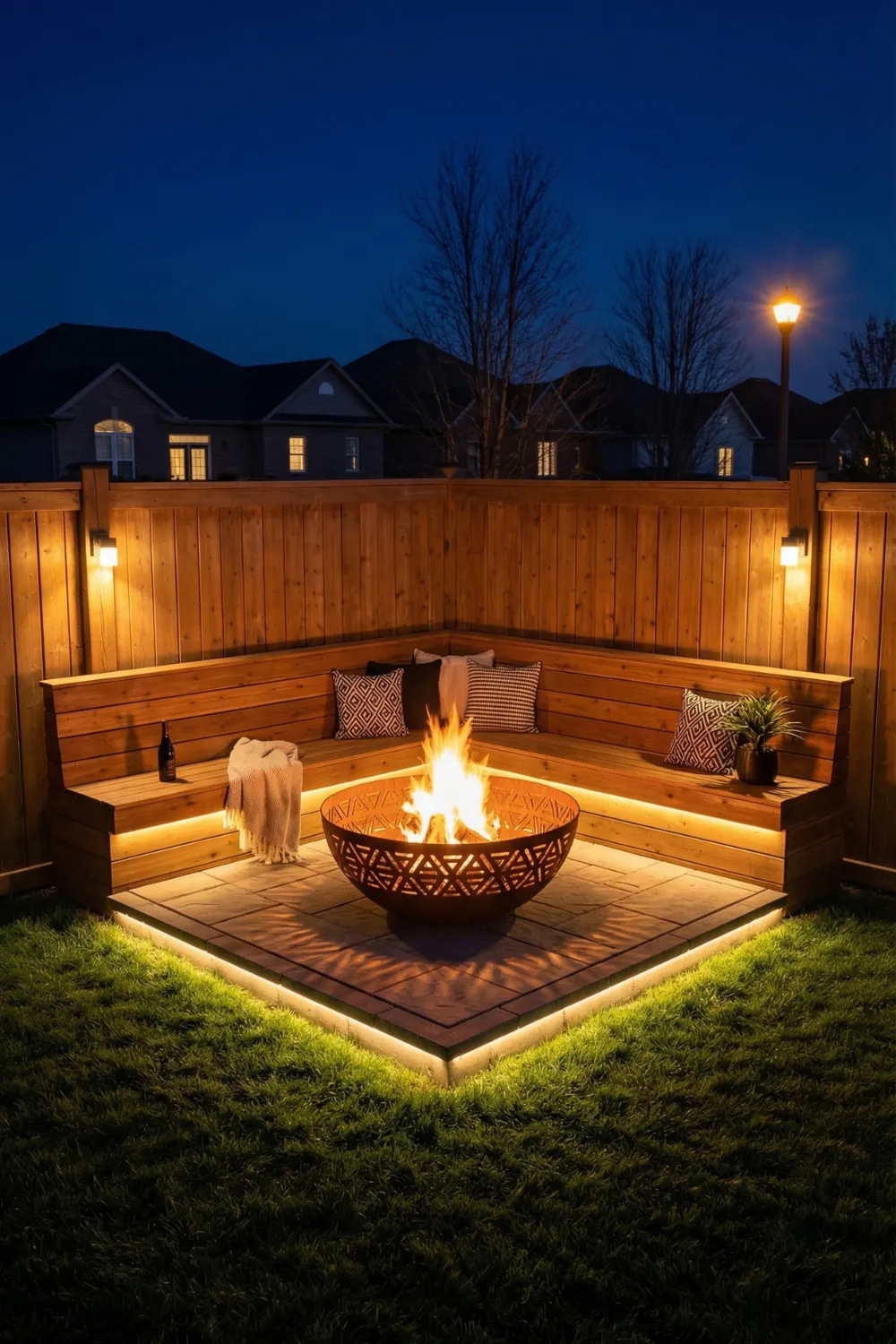
Fire pits work in corners for a reason that goes beyond aesthetics: the corner creates a sense of gathering that an open yard simply cannot. When you sit around a fire in an open space, people tend to spread out and drift. When the fire is in a corner, the fences act as a gentle backstop. Seating naturally angles toward the fire and toward each other. Conversations happen more easily.
Built-in L-shaped bench seating that follows the fence lines is the most satisfying approach here. Fixed seating signals permanence. It tells anyone who sits there that this space was designed for exactly this purpose, and that intention is felt even if nobody consciously identifies it.
Gravel or stone underfoot handles embers safely and ages well. Soft strip lighting under bench edges extends the usability of the space into the evening. Outdoor cushions in weather-resistant fabric soften the hardscape and make the bench something people actually want to sit on for more than twenty minutes.
Fire Pit Corner Essentials
- Built-in L-shaped bench seating along fence lines — fixed seating signals permanence
- Gravel or stone floor treatment — handles embers and ages gracefully
- Soft strip lighting under benches for evening ambiance
- Weather-resistant cushions — comfort determines how long people actually stay.
6 • Curved Garden Beds That Soften Hard Corners
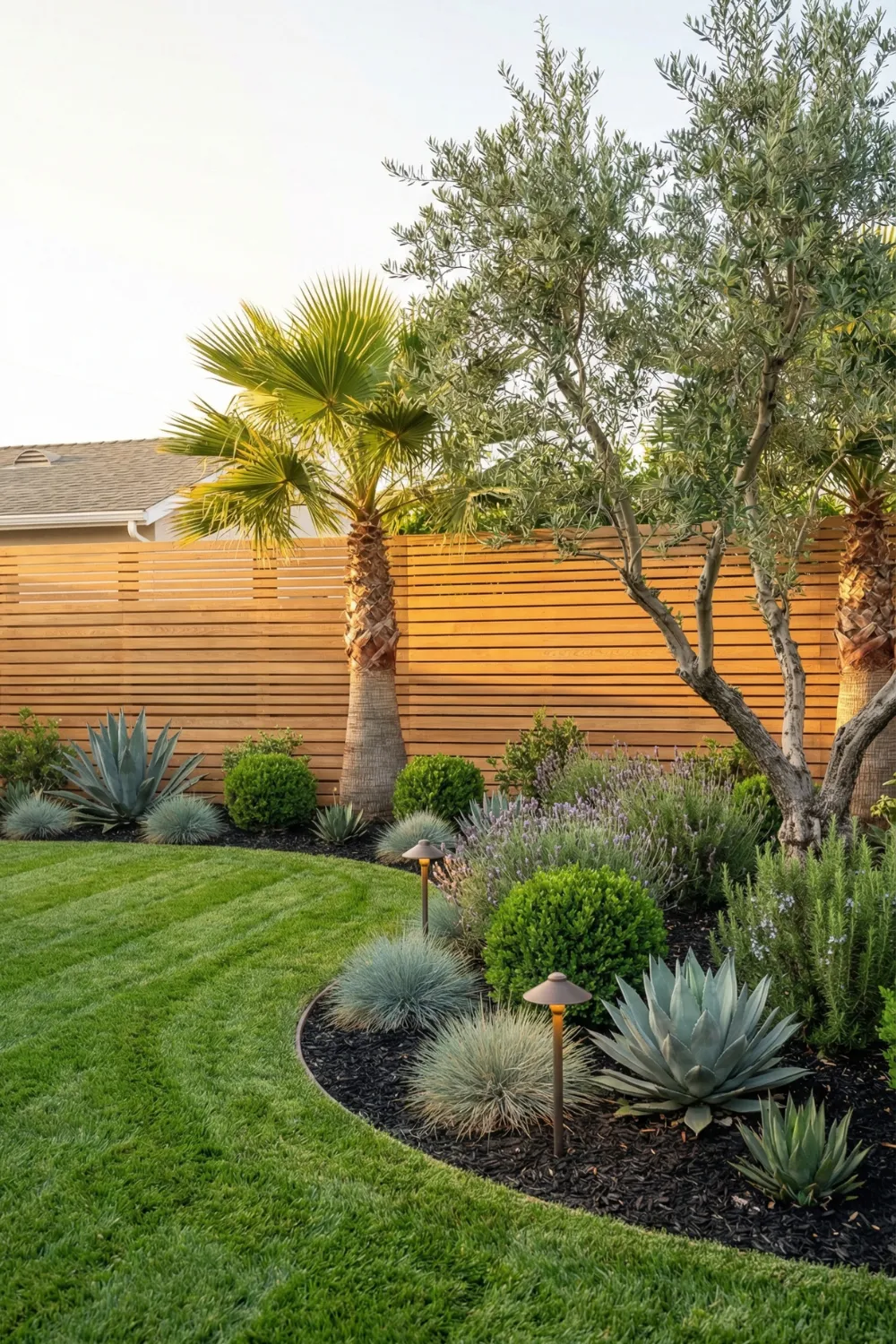
Not every corner improvement requires furniture or structure. Sometimes the most effective solution is purely botanical. A well-designed garden bed can transform a bare corner into something that looks intentional and beautiful without involving a single piece of outdoor furniture.
The curve is doing critical work here. A straight-edged bed in a corner just emphasizes the angular geometry of the fence junction. A curved bed edge — one that sweeps outward from the corner and returns to the fence line on a gentle arc — guides the eye smoothly through the space instead of stopping it at a hard angle.
Layered planting is what separates a garden bed that looks designed from one that just looks like plants were put somewhere. Tall plants at the back against the fence. Mid-height plants filling the middle zone. Low ground covers defining the front edge. Dark mulch between plants sharpens the contrast and makes every color read more clearly.
7 • Garden Nooks Designed for Quiet and Atmosphere
There is a difference between a backyard that looks good and a backyard that makes you feel something when you walk into it. Garden nooks are in the second category. They are not about function in the conventional sense. They are about having a place in your own outdoor space that feels like it belongs to you specifically.
A simple bench, positioned in the corner with plantings on both sides and something overhead — even just a modest arch or a few hanging plants — creates a sense of arrival that larger, more open spaces cannot replicate. You feel like you have walked into somewhere, not just stood in a yard.
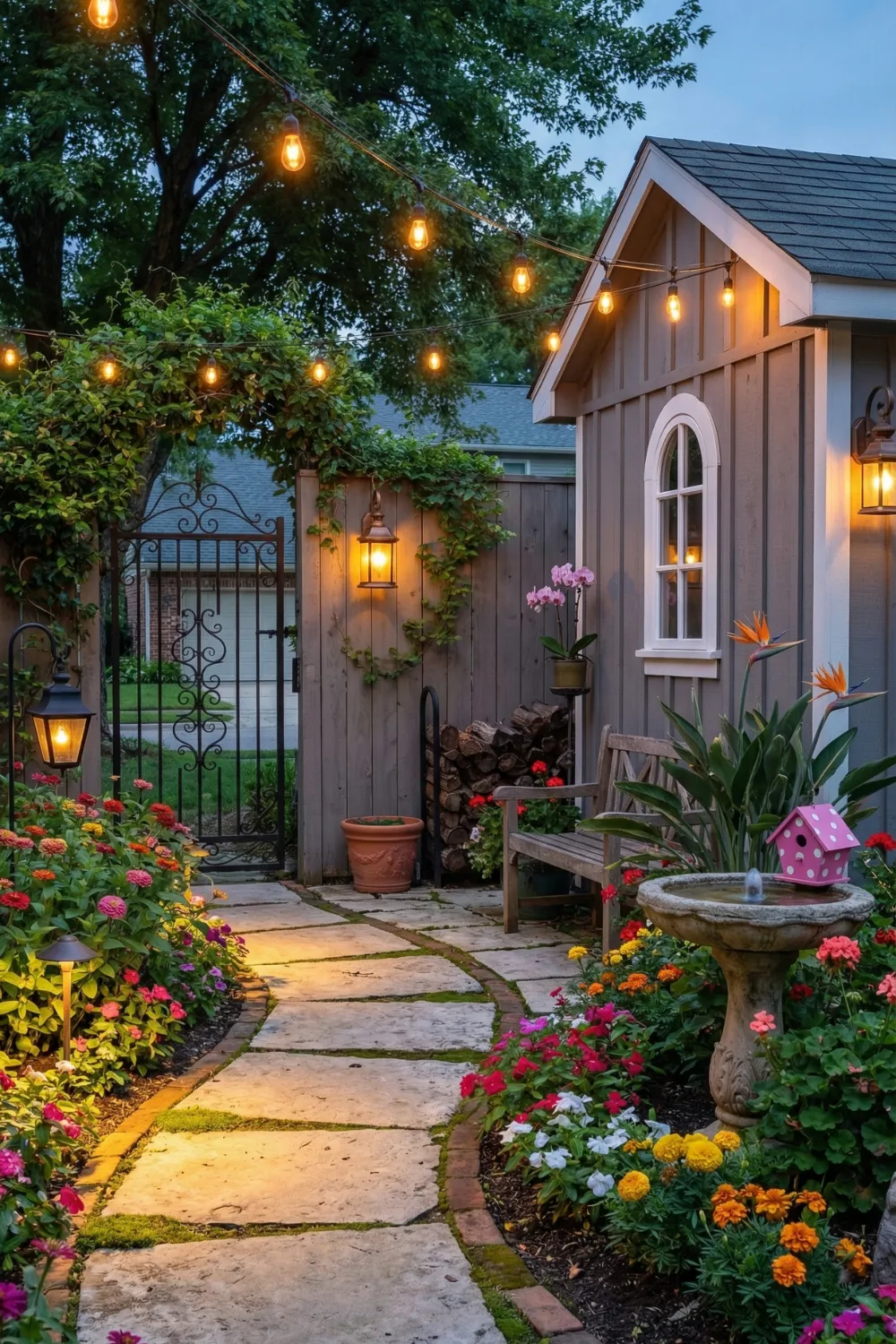
Layered lighting transforms these spaces most dramatically after dark. String lights overhead create a canopy effect. A lantern or two at ground level adds warmth. A small wall-mounted fixture on the fence face provides directional illumination. Together, these layers create an atmosphere that no single light source can achieve alone.
8 • Hammock Retreats — The Simplest Upgrade With the Best Return
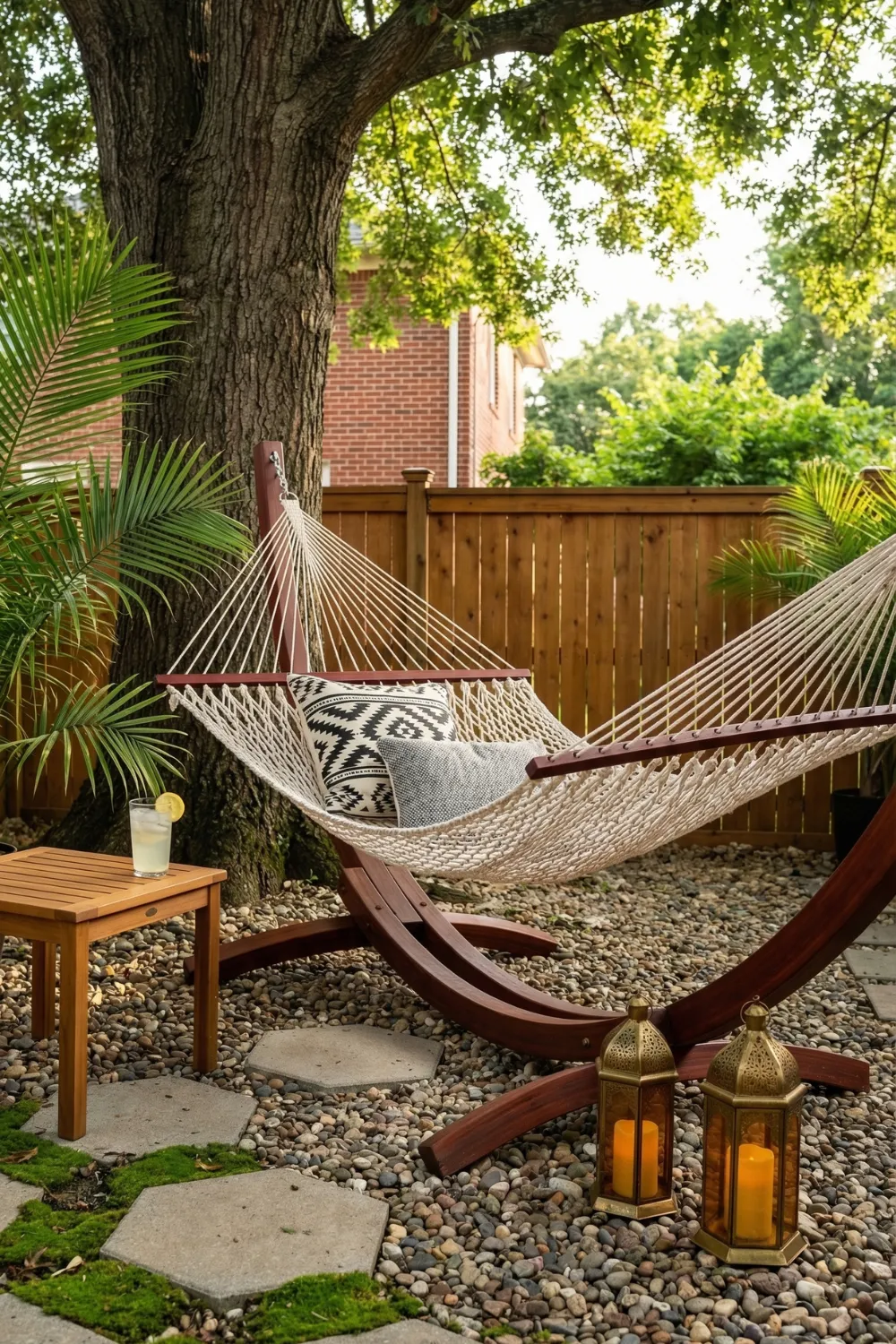
If you want the highest possible ratio of improvement to effort, a hammock corner is difficult to beat. Two anchor points, one hammock, and a corner that was previously useless becomes a destination that gets used almost every day in warm weather.
The key to making it look designed rather than improvised is the ground treatment. A hammock hanging above bare dirt or struggling grass looks temporary. The same hammock above a defined area of gravel or mulch — with a clear edge separating it from the surrounding lawn — looks permanent and intentional.
Stepping stones leading from the main yard into the hammock area extend that sense of intention. A small side table nearby, a few potted plants around the perimeter, and perhaps one low lantern — these additions take the setup from utilitarian to genuinely inviting without requiring any structural work at all.
9 • Arbor Structures as Vertical Focal Points
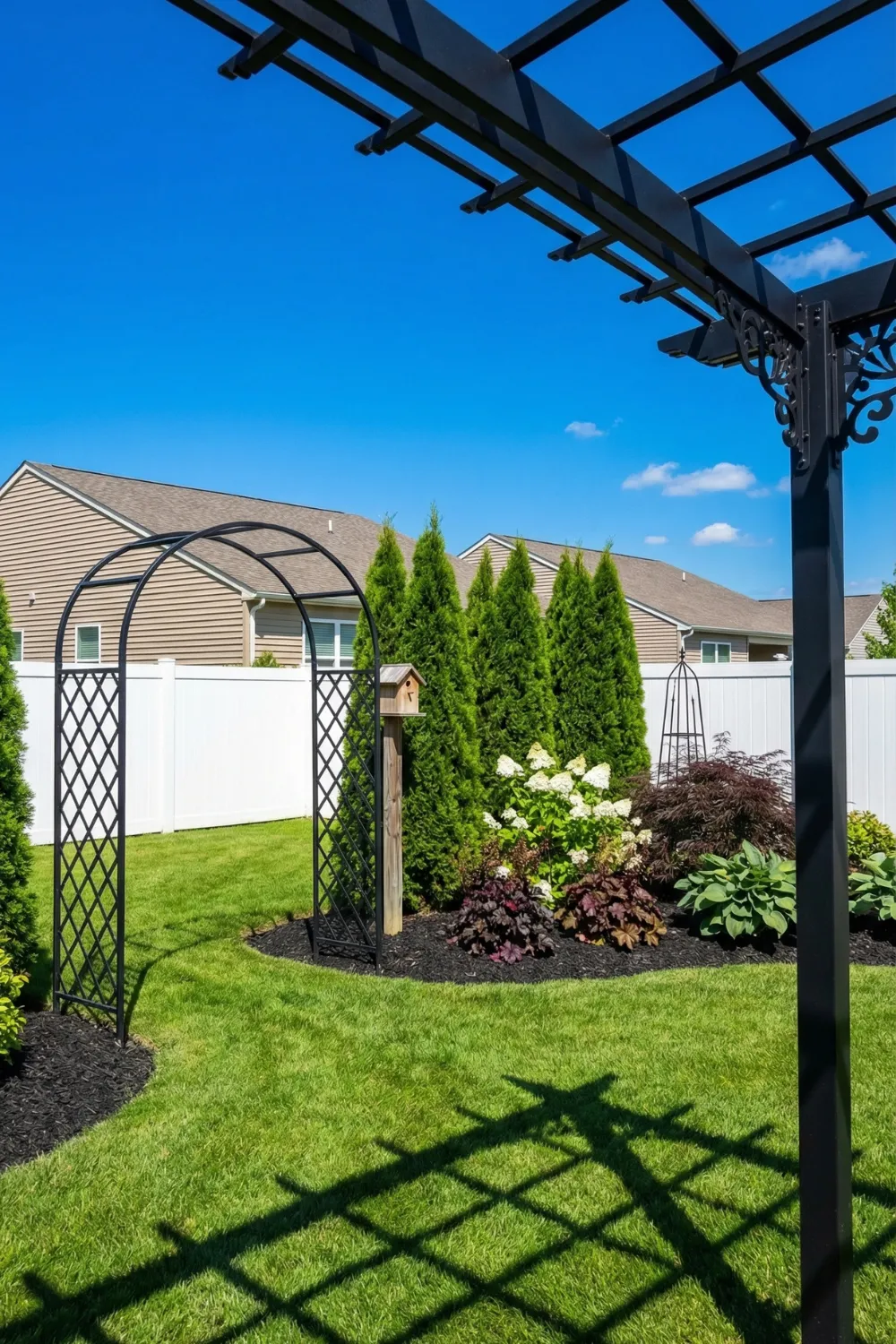
The fundamental visual problem with most backyard corners is not the corner itself — it is that everything in that part of the yard is the same height. Fences run horizontally. Lawns are flat. The eye has nothing to move toward and nothing to move up to. An arbor solves this problem directly.
A well-placed garden arbor at a corner creates a focal point: a place in the landscape that draws attention and gives the space a sense of direction. Without a focal point, a yard is just an area. With one, it becomes a composition — something with a visual logic that feels resolved rather than random.
Climbing plants are what transform an arbor from a structure into a living feature. Roses, clematis, wisteria, jasmine — any of these will eventually cover the arbor’s frame and create something that looks genuinely beautiful and permanent. The plant beds around the base should follow the layered approach: taller plants behind, shorter in front, clear edge defining where planting ends.
10 • Stone Arch Seating Areas for a True Garden Retreat
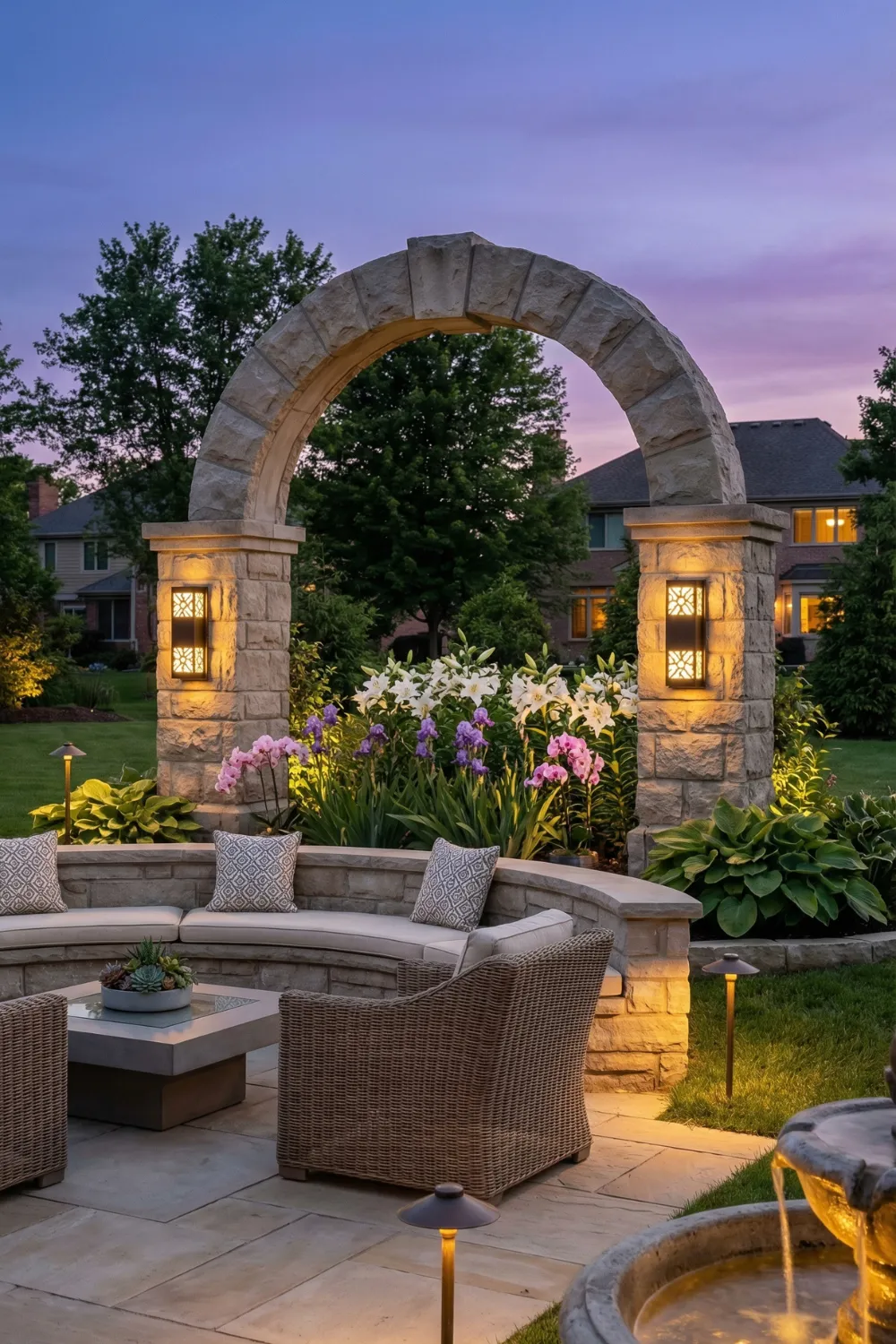
There is a category of backyard corner that calls for something more architectural. For these situations, a stone arch framing a seating area is one of the most effective solutions available.
The arch does something that simpler structures cannot: it creates a threshold. Walking through or sitting beneath an arch signals arrival in a way that walking into an open space does not. The seating area on the other side feels defined and separated from the rest of the yard. It feels like a place.
A curved bench placed under the arch echoes its shape in a way that feels visually satisfying. Soft plantings around the stonework soften what could otherwise feel too formal. Lighting built into the stonework or positioned to illuminate the arch from below after dark makes the feature work in both daylight and evening.
11 • Water Features That Change the Whole Feeling of a Corner
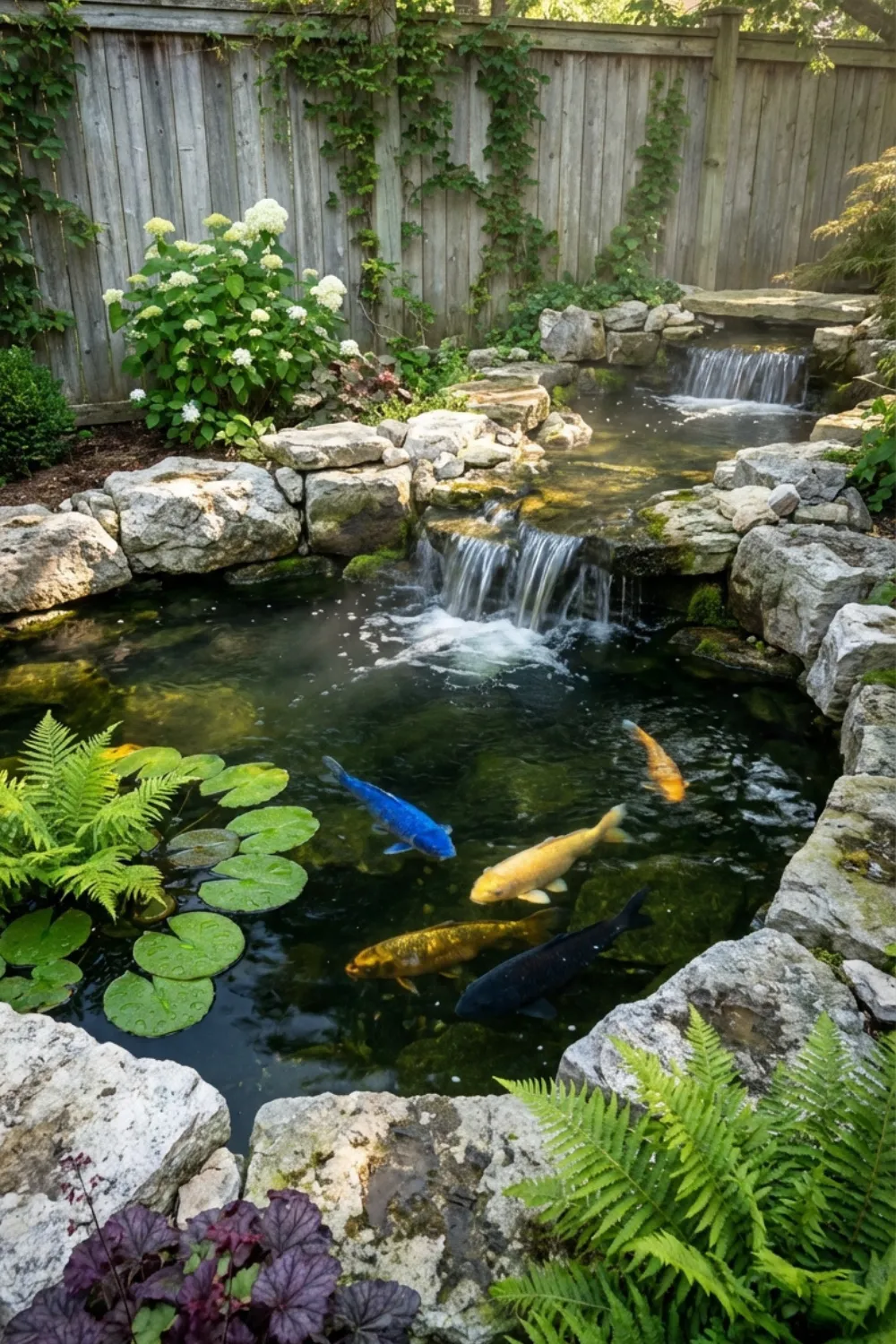
Sound is an underused design element in backyard spaces, and water features are how you introduce it. The difference between a corner with a pond or small fountain and the same corner without one is not just visual — it is auditory and atmospheric. Moving water changes how a space feels to be in, not just how it looks.
Corner water features work especially well because the enclosure created by two fence lines amplifies the sound of water in a pleasing way. Even modest movement and sound create a sense of life and activity that static elements — however beautiful — cannot replicate.
Natural stone used in and around water features is the material that ages most gracefully. Aquatic plants like water lilies soften the edges of a pond. Foliage planted around the water feature frames it and turns the corner into something that feels genuinely curated. Subtle underwater lighting extends the effect into evening.
12 • Flower Beds That Add Color, Texture, and Seasonal Life
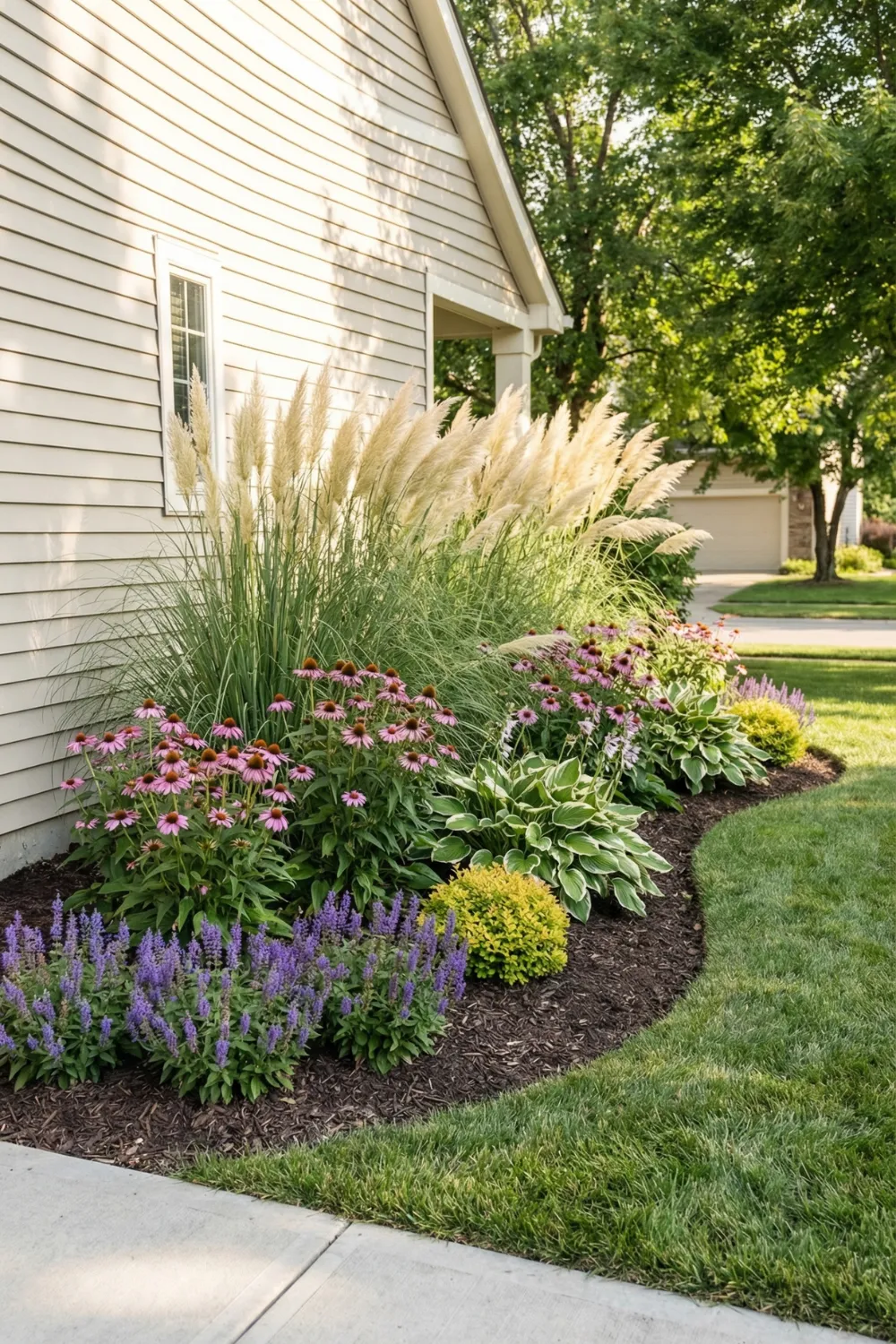
Sometimes the most honest answer for a neglected corner is also the simplest one: plant something beautiful and maintain it properly. A well-designed flower bed does not require structural investment. It requires good plant selection, a clear edge, and the layered approach that makes the difference between a bed that looks designed and one that just looks like plants were added.
The “thriller, filler, spiller” principle translates directly to in-ground beds. Taller dramatic plants at the back and center provide structure. Mid-height flowering plants fill the middle and add color. Low-growing plants at the front edge soften the transition between bed and lawn.
Soft palettes — pale lavender, white, soft yellow, sage green — tend to read as peaceful and considered. Mulch between plants serves both a practical purpose and an aesthetic one: it unifies the bed and makes every plant color read more cleanly against a consistent dark background.
13 • Why Corner Spaces Can Become the Best Part of the Entire Yard
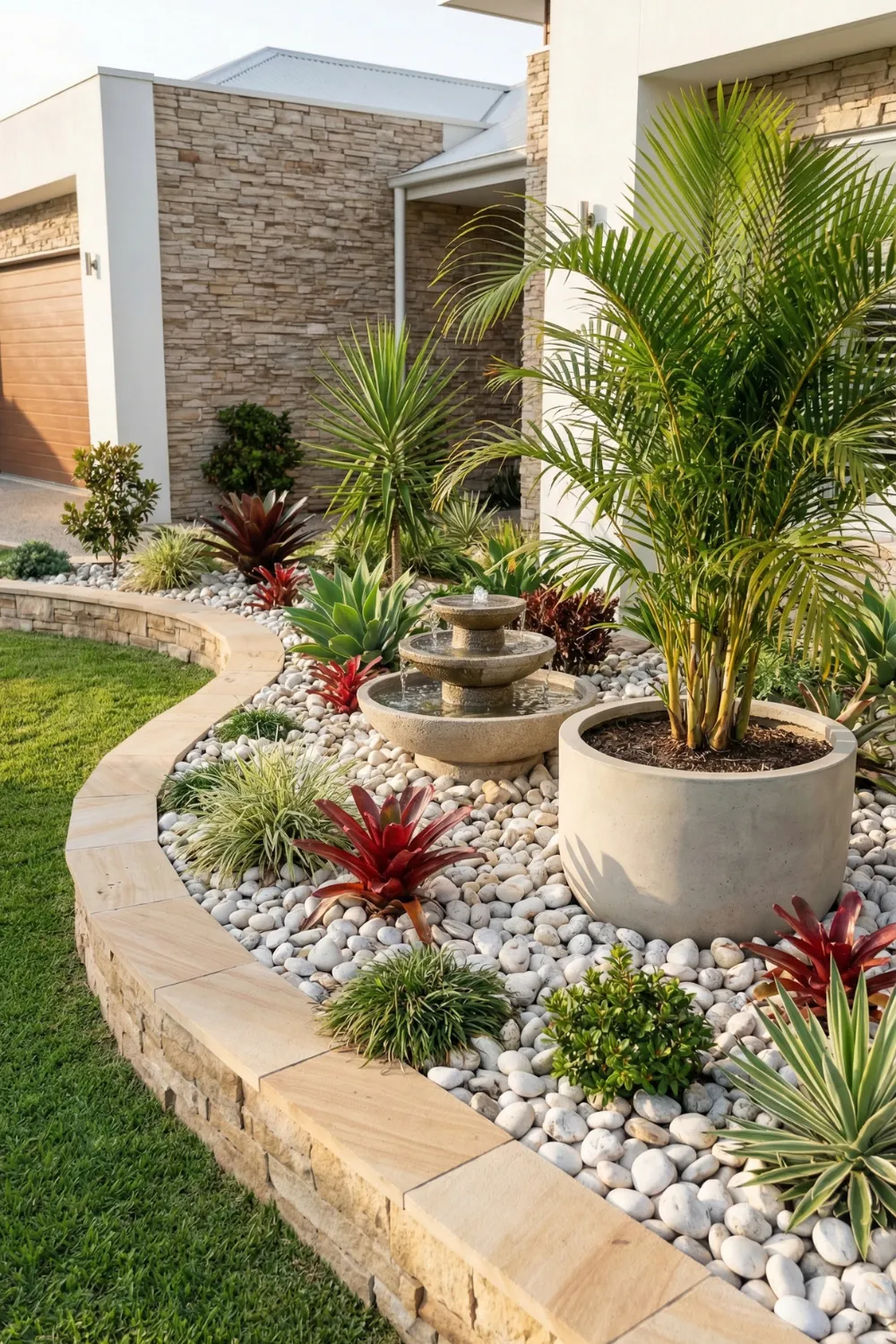
There is something satisfying about a transformation that happens in the place you least expected it. The corners of a backyard are not where most people look when they imagine improvement. And yet, when they are designed thoughtfully, they often become the part of the yard that people are most drawn to — the place guests drift toward, the spot you find yourself in at the end of a long day.
The enclosed quality that makes corners feel awkward before they are designed is exactly what makes them feel special after. Open yards can be beautiful, but they lack the intimate quality that comes from having something behind you. A designed corner has that quality built in. The fence lines were always there. The enclosure was always there. All that was missing was someone deciding what to do with it.
The range of approaches in this guide covers most budgets and most skill levels. But all of them start in the same place: standing in the corner, looking at what is already there, and deciding to treat it like it matters. Because it does. It has been waiting to.
Where to Start — Quick Decision Guide
- Weekend project: hammock + gravel pad + stepping stones
- One month project: curved garden bed with layered planting + lighting
- Seasonal project: pergola + climbing plants + curved seating + ground treatment
- Long-term investment: outdoor kitchen, water feature, or stone arch seating are
- All budgets: define the purpose first — everything else follows from that