
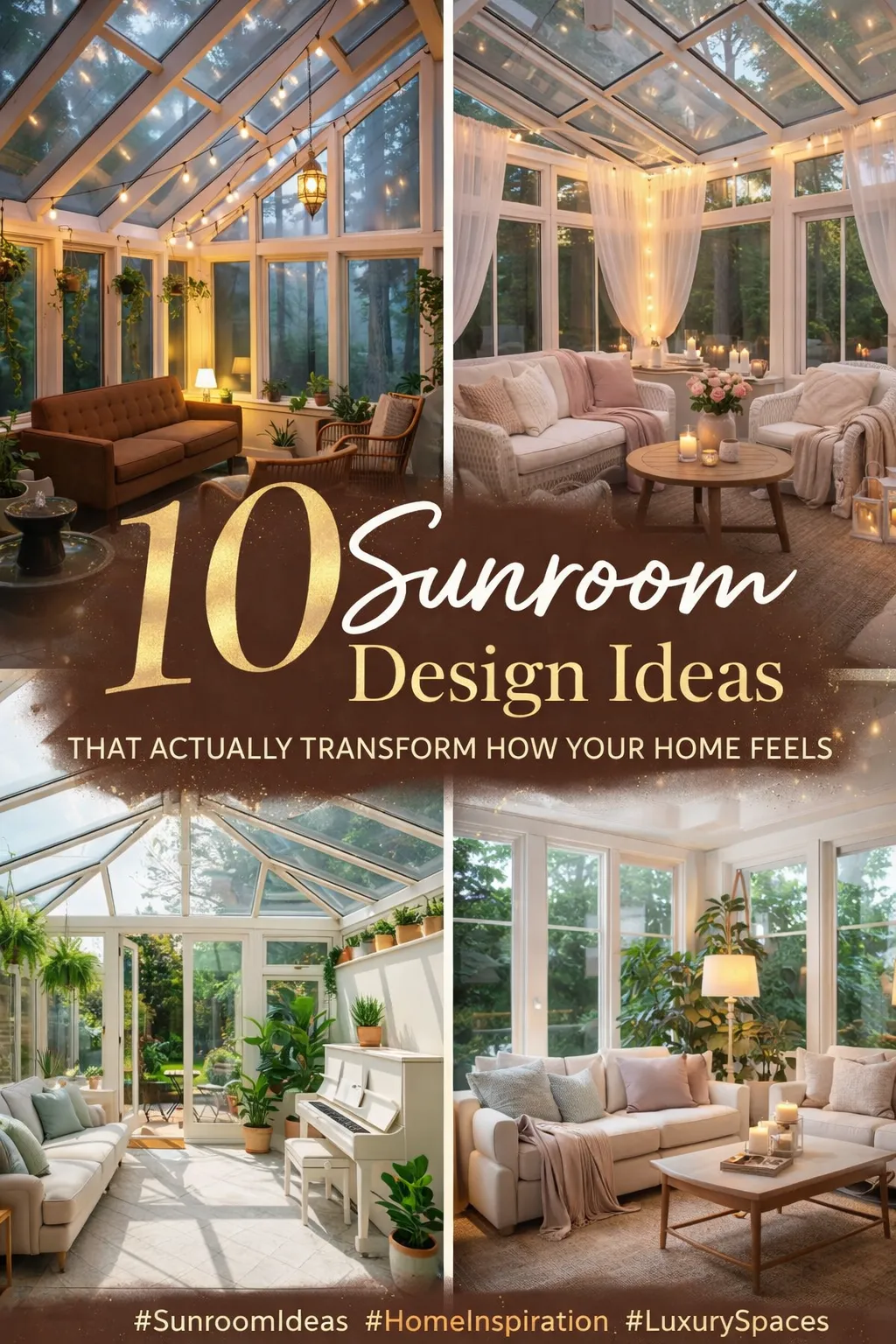
Most rooms in a house serve a fixed purpose. The kitchen cooks. The bedroom sleeps. The bathroom does what bathrooms do. A sunroom is different — it’s the room that can become almost anything, and that flexibility is both its greatest strength and its most common design failure.
An under designed sunroom becomes a holding area for furniture that doesn’t fit anywhere else, a slightly-too-bright room nobody quite knows what to do with, a space that’s beautiful for about three weeks in spring and uncomfortable the rest of the year. A well-designed sunroom, by contrast, becomes the room people gravitate toward without being invited — the one that earns its floor space every single day.
The difference is almost never about budget. It’s about understanding how light moves through the space, how furniture placement creates or destroys comfort, and how material choices determine whether a sunroom feels like an extension of the home or an afterthought attached to it. These ten designs illustrate what getting those decisions right actually looks like.
Table of Contents
- 1. Cozy Covered Sunroom With Lounge Vibes
- 2. Glass Roof Sunroom for Golden Hour
- 3. Sunroom Turned Creative Studio
- 4. Built-In Bench Family Sunroom
- 5. Modern Sunroom With Playful Touches
- 6. Elegant Dining Sunroom
- 7. Romantic Cottage Sunroom
- 8. Warm Boho Sunroom Retreat
- 9. Bright Entertaining Sunroom Lounge
- 10. Casual Coastal Sunroom Seating
- 11. Design Principles Behind Every Sunroom That Actually Gets Used
- 12. FAQs
1. Cozy Covered Sunroom With Lounge Vibes — When Outdoor Space Becomes Indoor Room
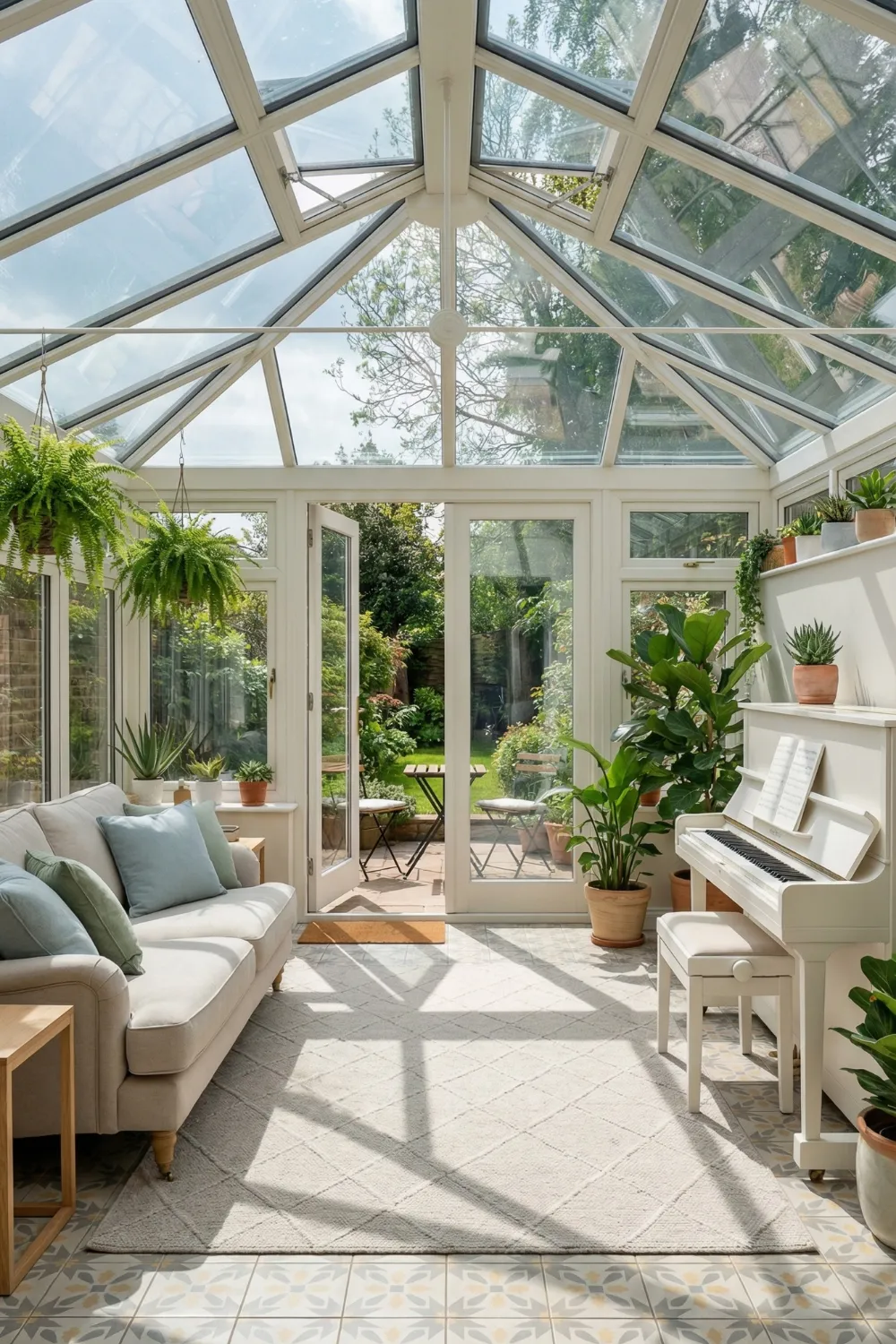
The most transformative decision in sunroom design is also the simplest to state: treat it like a living room, not like a patio. The moment furniture, rugs, lighting, and layout follow interior design logic rather than outdoor furniture logic, the space crosses a threshold from “pleasant bonus area” to “room people actually want to be in.”
Upholstered seating — genuine indoor-grade fabric, not weather-resistant synthetic — changes the tactile and visual quality of a sunroom completely. Paired with a properly sized area rug that grounds the seating arrangement and a central coffee table that gives the grouping a structural anchor, the result is a room that has the same composed quality as a living room. The fact that it has more glass than drywall becomes a feature rather than a limitation.
Creating the indoor-outdoor balance:
- Layer plants at three distinct heights — trailing at shelf level, mid-height potted specimens at floor level, and one larger architectural plant in a corner — so the greenery softens the transition between interior and exterior without creating a “plant collection” effect
- Ceiling fans solve two sunroom problems simultaneously: they manage summer heat and keep air moving, and they provide a ceiling-level design element that prevents the overhead space from feeling like an empty glass void
- Warm neutral upholstery paired with deep green plants creates the calm contrast that defines this format — the colours are related through their shared organic quality without being matchy
- Natural light control is the practical priority: solar shades or sheer curtains that filter rather than block are the solution for sunrooms that face east or west and receive direct morning or afternoon sun
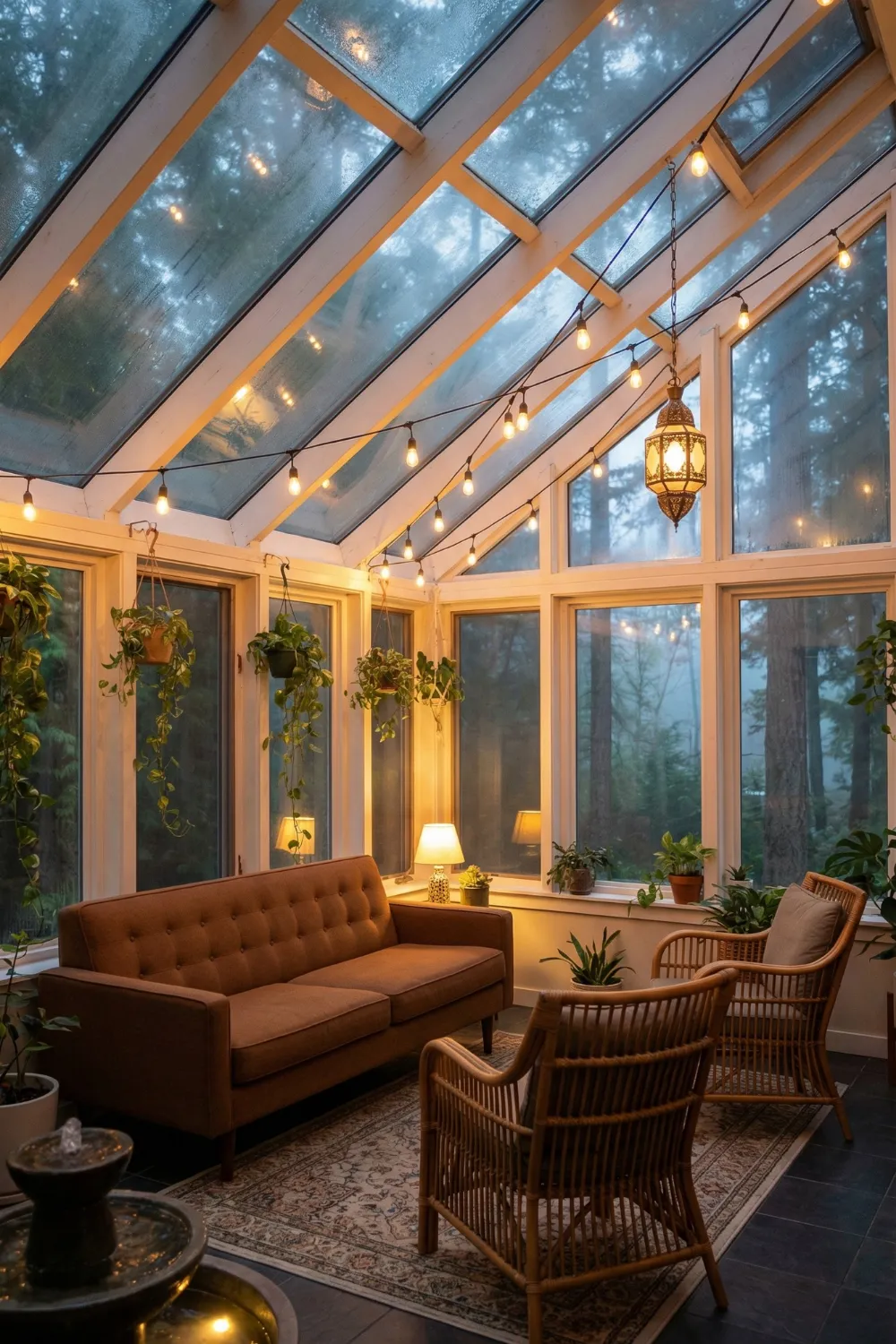
2. Glass Roof Sunroom for Golden Hour — Light as the Primary Material
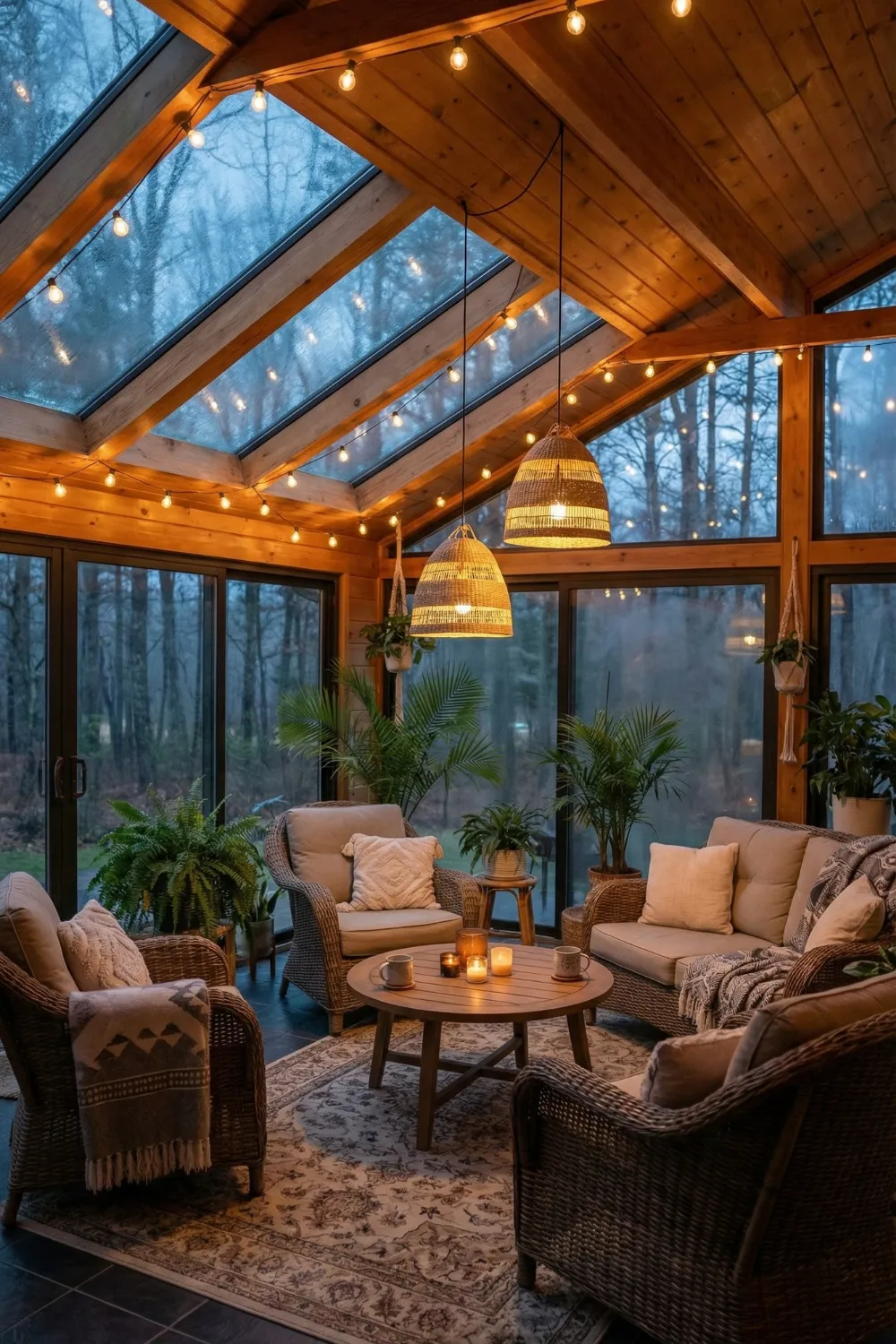
The glass ceiling sunroom is the purest expression of what a sunroom can be when design prioritises light as the dominant material rather than treating it as something to be managed. Daylight moves through the space all day — angle, intensity, and colour shifting continuously from morning cool to afternoon warm to the amber quality of late afternoon that makes every surface look better than it has any right to.
The design discipline this format requires is restraint. When light is the primary design element, decoration competes with it rather than supporting it. Low-profile furniture preserves sightlines. A warm, restrained palette — natural rattan, soft textiles in cream and warm sand — reflects light rather than absorbing it. Surfaces that glare (high-gloss finishes, chrome hardware) are avoided because they create harsh reflections that undermine the soft quality of natural light that makes this format special.
Layering artificial light for evening continuity:
- The transition from daylight to evening is the critical moment in a glass-ceiling sunroom — without a thoughtful artificial lighting plan, the room that was magical at 4pm becomes cold and uninviting at 7pm
- String lights, pendant fixtures, and table lamps working together maintain the warm, multi-source quality that natural light provides during the day
- Warm-toned bulbs (2700K–3000K) are non-negotiable — cool white light in a glass-ceiling space at night reads as institutional rather than intimate
- Natural materials (rattan, linen, jute) absorb and diffuse light rather than reflecting it harshly, which prevents the glass ceiling from creating an echo-chamber of brightness
3. Sunroom Turned Creative Studio — Natural Light as a Functional Tool
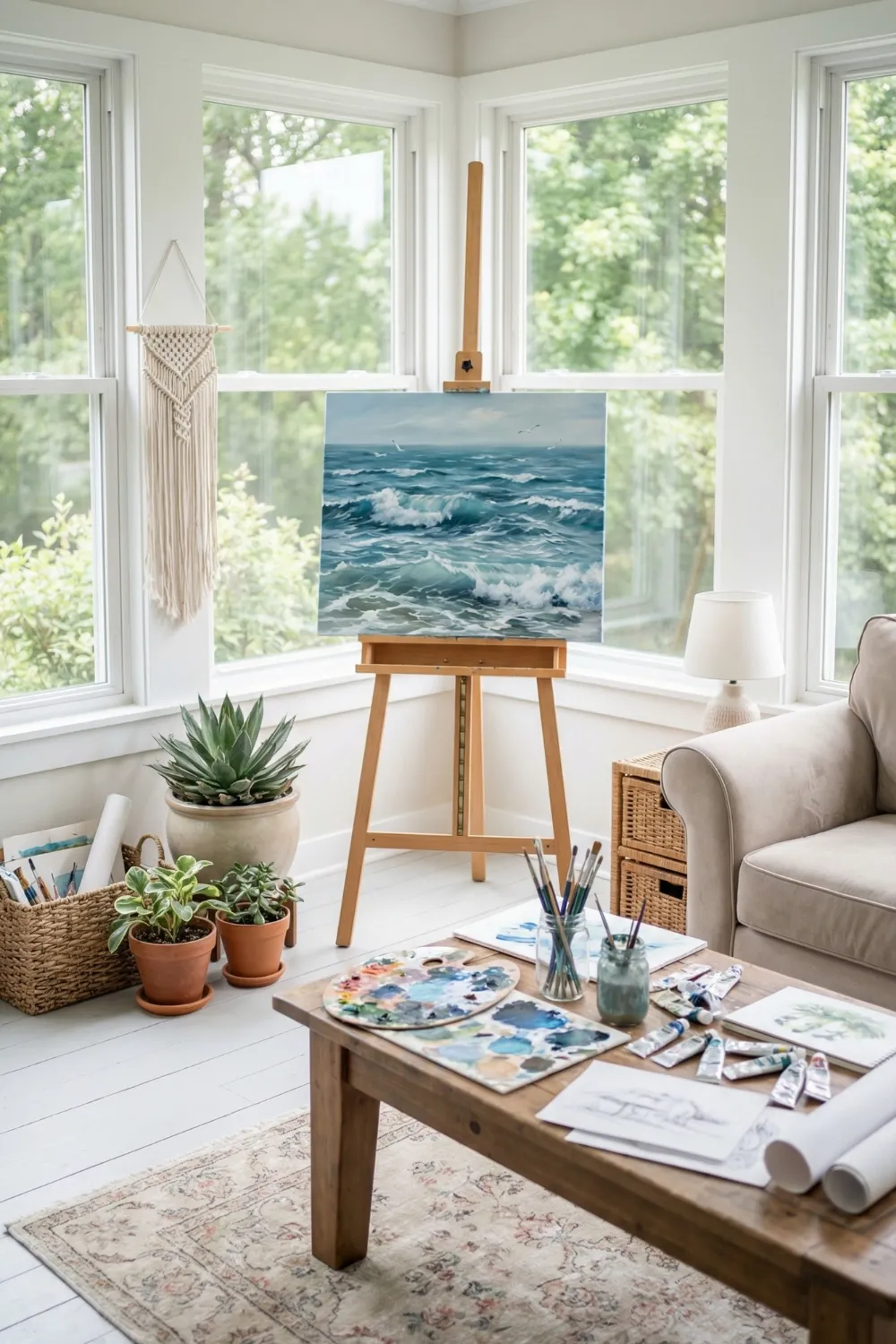
Natural light isn’t just aesthetically valuable in a creative workspace — it’s functionally superior to artificial light for most creative work. It renders colours accurately, reduces eye strain over long sessions, shifts in quality throughout the day in ways that refresh focus, and provides the kind of diffused, non-directional illumination that minimises the harsh shadows that cause problems in fine detail work.
The design principle in a sunroom studio is functional minimalism: every element earns its place by serving the work, and nothing is added for decoration that doesn’t also improve the working conditions. An easel positioned to receive even north or east light. A neutral palette that doesn’t introduce colour bias. Open floor space that allows furniture to be rearranged as projects change. Storage that contains supplies without eliminating them from reach.
Organising a creative sunroom for real work:
- Position the primary work surface perpendicular to windows rather than facing them directly — facing a bright window causes glare and silhouettes the work; having light come from the side provides the even, directional illumination that reveals surface detail
- Neutral walls and floors are a functional choice in a studio context, not just an aesthetic one — coloured surfaces cast colour onto the work and distort perception in ways that accumulate over long sessions
- Woven baskets and soft rugs are the materials that prevent a functional minimalist space from reading as sterile — they add tactile warmth without introducing visual complexity that competes with the work itself
- Keep the vertical surfaces clear — resist the instinct to fill walls with inspiration boards and reference material; in a glass-walled space, the windows are already providing the most effective visual stimulus available
4. Built-In Bench Family Sunroom — Edge Activation as Space Strategy
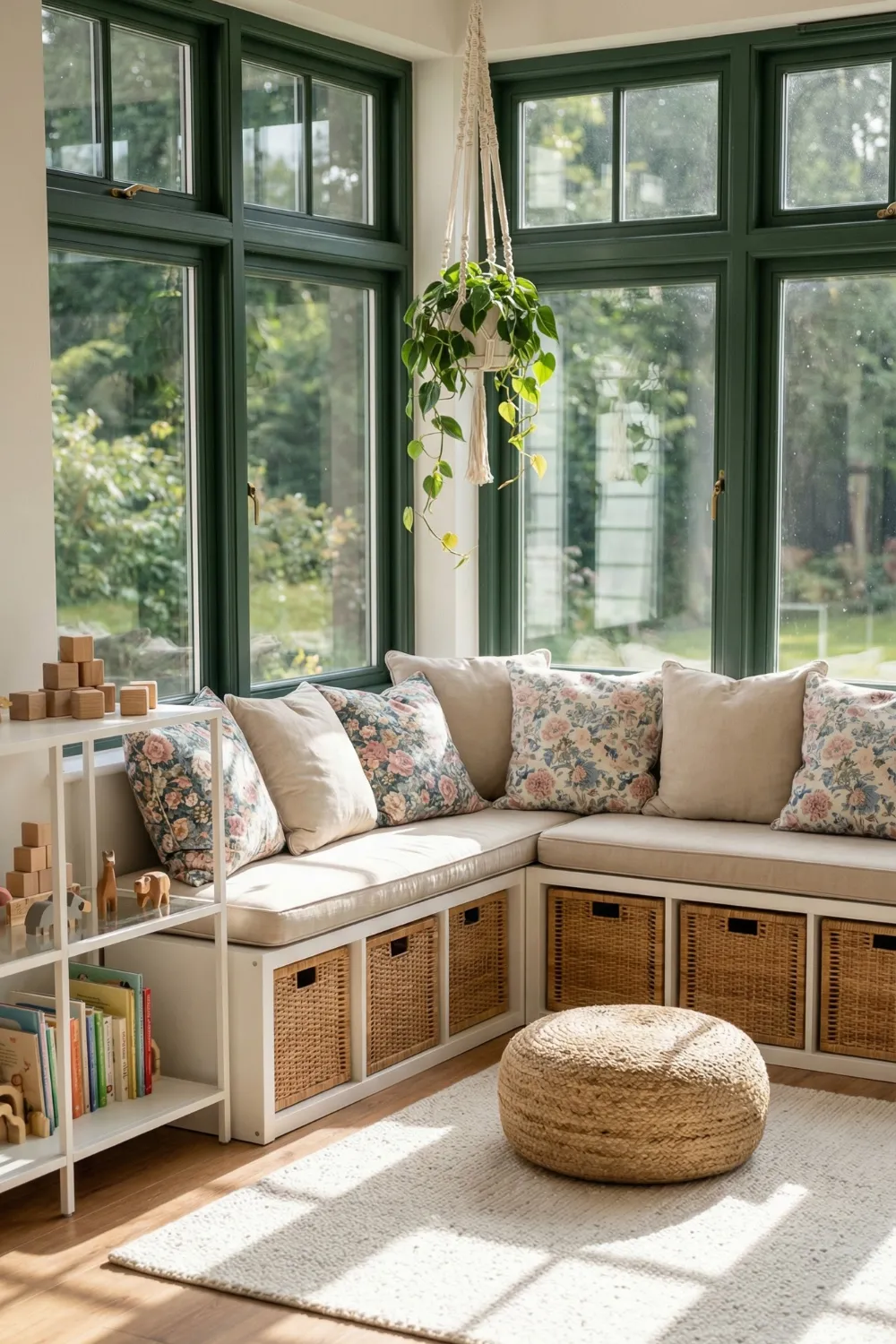
The built-in bench sunroom solves a problem specific to rooms that need to accommodate multiple users over extended periods: how to maximise seating without filling the floor plan with furniture that limits flexibility and makes the space feel smaller than it is.
Running built-in benches along window walls is the architectural solution: seating is created at the perimeter where it doesn’t obstruct circulation or block sightlines, the structural connection to the wall provides stability without requiring floor space for legs and frames, and the under-seat volume becomes storage that would otherwise require additional furniture. The floor plan remains open. The room feels larger. The seating capacity is often double what the same square footage could accommodate with freestanding furniture.
Making built-ins work practically:
- Seat cushion thickness matters more than most people expect in a built-in context — at least three inches of quality foam is required for comfort over extended periods; thinner cushions feel like park benches within twenty minutes
- Washable cushion covers are the practical requirement for any sunroom used by children — choose fabric that’s durable enough for daily use and cheerful enough that its purpose isn’t immediately obvious
- Under-seat storage with lift-top or drawer access gives the space a genuine organisational function: books, toys, blankets, games — all the items that sunrooms accumulate — have a designated home that’s invisible from the primary seating position
- The colour contrast between window frames and upholstery is a design decision worth considering deliberately — deep frames with light upholstery creates graphic definition; matching tones creates a calmer, more unified appearance
5. Modern Sunroom With Playful Touches — Contrast Control as the Design Method
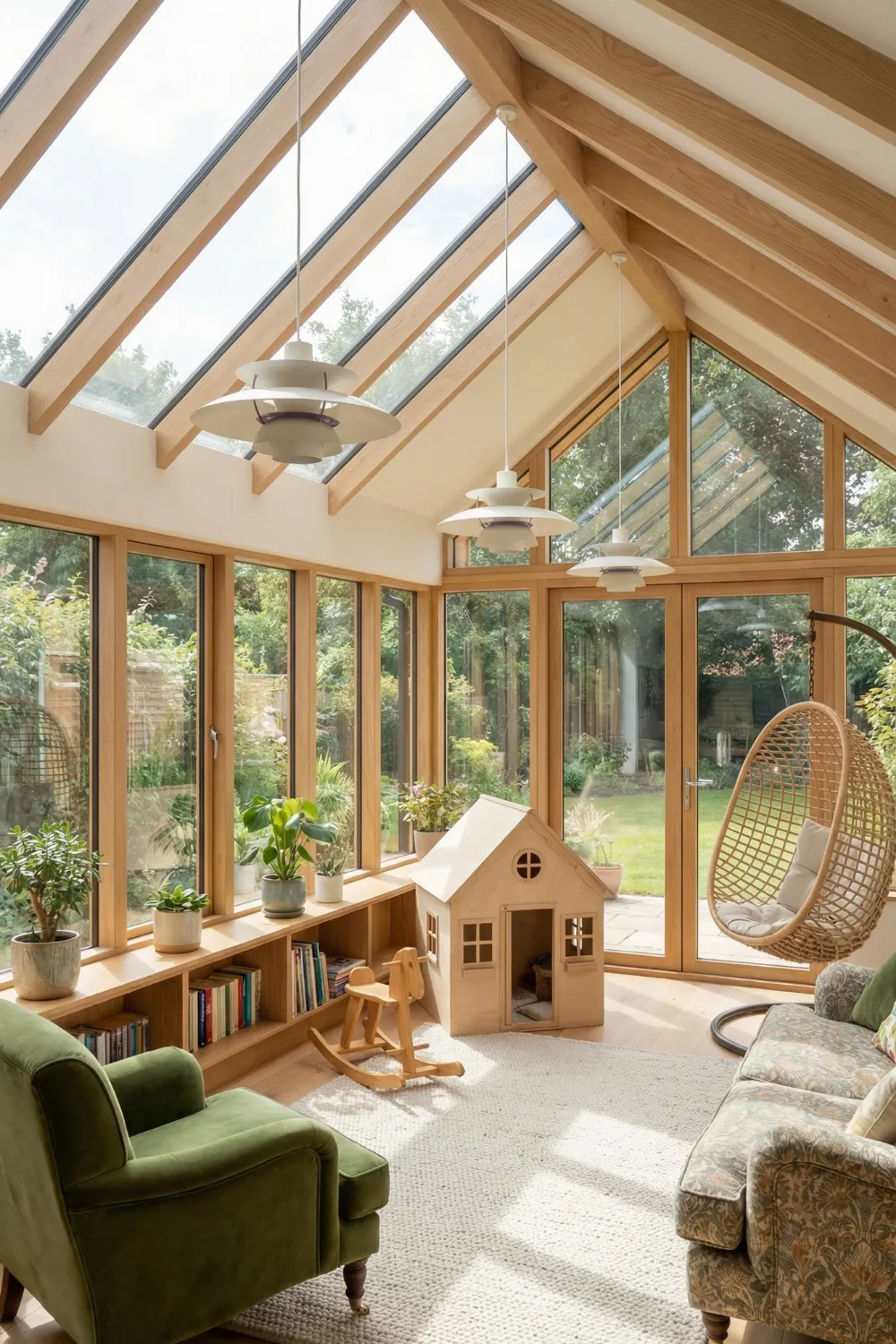
The challenge of a modern sunroom with family-friendly intentions is navigating the tension between the clean geometry and restraint that modern design requires and the warmth and visual interest that makes a space genuinely comfortable to spend time in. Too far in one direction and the room feels cold and unwelcoming. Too far in the other and it feels busy and overstimulating.
The solution is contrast control: applying modern architectural elements (clean lines, geometric windows, structured shelving, precise proportions) as the framework, then introducing softness and warmth (rounded furniture profiles, natural wood tones, soft textiles, organic plant forms) as the layer that makes the framework livable. The two registers don’t compete — they define each other’s qualities more clearly by coexisting.
Practical contrast management:
- One or two rounded furniture pieces (a curved sofa arm, a round ottoman, a circular rug) in an otherwise rectilinear space do the softening work that would otherwise require many small soft elements — the rounded form registers immediately as a counterpoint to the surrounding geometry
- Vertical shelving that reaches toward the ceiling draws the eye upward in the same way that tall cabinetry increases perceived ceiling height in kitchens — this is particularly effective in sunrooms where the generous window height already implies vertical openness
- Leaving deliberate breathing room between objects — resisting the instinct to fill every surface and corner — gives the eye the visual rest it needs to appreciate the objects that are present
- Consistent material repetition (the same wood tone appearing in the floor, a shelf, and a small accessory) creates cohesion across a room with multiple functional zones
6. Elegant Dining Sunroom — Refinement Without Rigidity
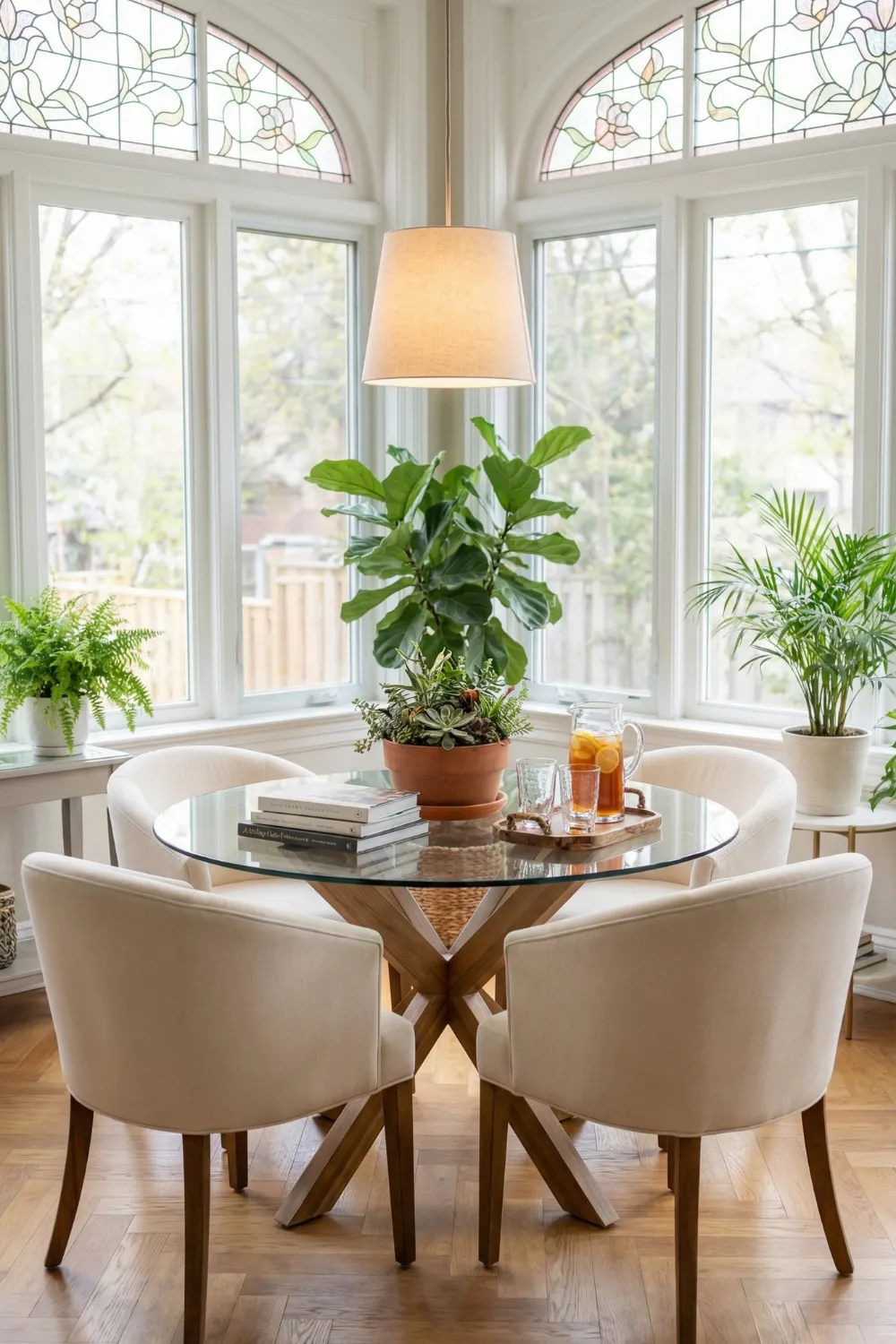
A dining sunroom occupies a specific design space between the formality of a traditional dining room and the casual informality of eating outdoors. The design challenge is getting that balance right: refined enough that the experience of eating there feels special, relaxed enough that it doesn’t feel like a room reserved for occasions.
The round table is the central design decision in a sunroom dining setup, and it earns its position. Round tables improve conversation by eliminating the hierarchy of ends and sides. They allow more flexible seating numbers than rectangular tables. And in a glass-walled space, the curved form provides a counterpoint to the rectilinear geometry of the window frames that makes the furniture arrangement feel more naturally comfortable than a rectangular table would.
Supporting the dining experience architecturally:
- A pendant light centred directly above the table is the defining element that turns a seating arrangement into a dining room — it creates the overhead focal point and intimate pool of light that makes the table feel like a destination rather than furniture positioned near windows
- Upholstered dining chairs rather than hard seats change the character of the experience significantly — they signal that meals here are intended to be long and comfortable rather than efficient
- Glass tabletops allow light to pass through the furniture rather than accumulating visual weight at table height, which keeps the room feeling open even when fully occupied
- Clear circulation paths of at least 36 inches around the table perimeter are the functional requirement that prevents an elegant sunroom dining space from feeling cramped when in use
7. Romantic Cottage Sunroom — Softness as a Design Decision
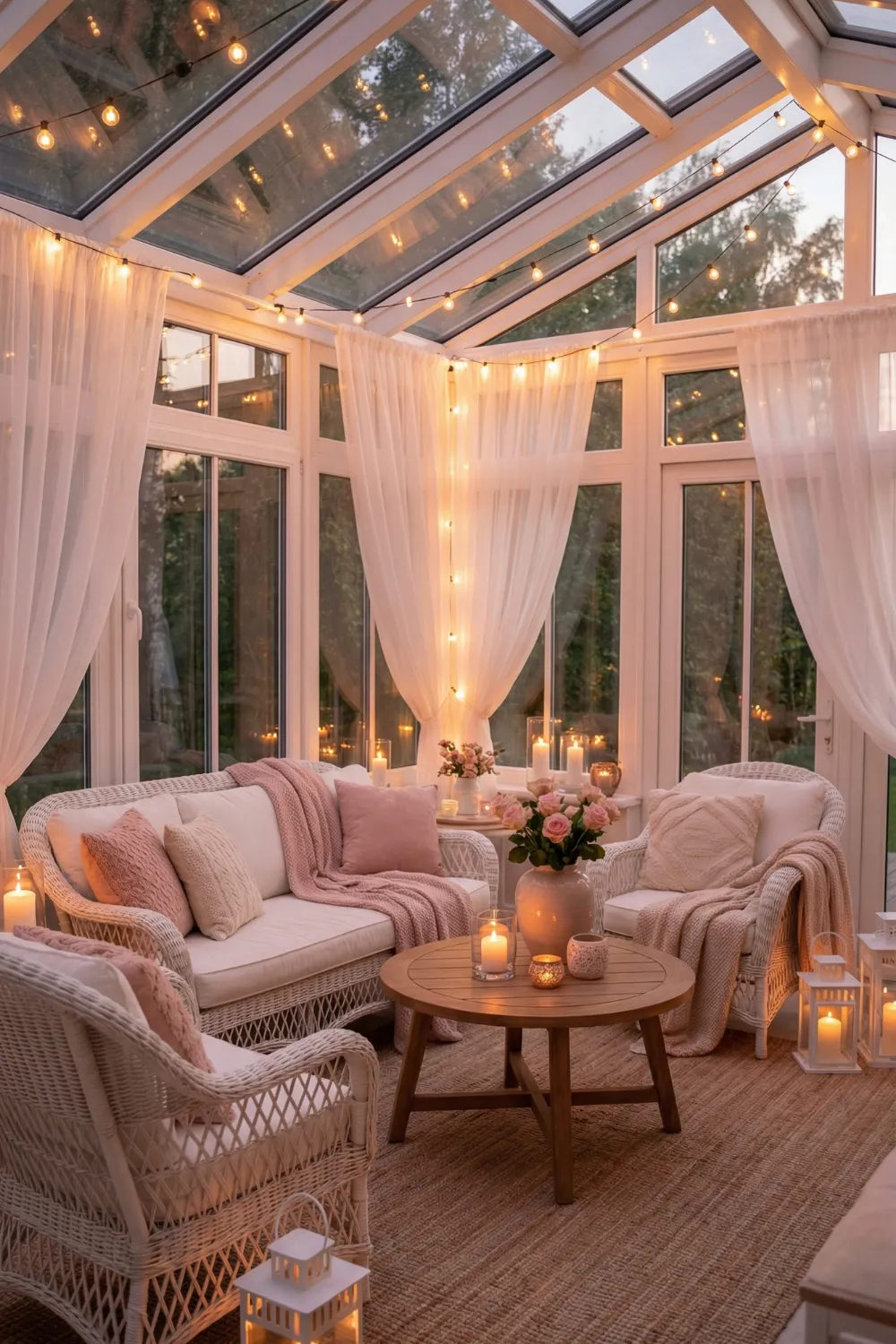
The romantic cottage sunroom achieves something that most design approaches don’t attempt: it treats softness not as a tonal or decorative choice but as a structural design strategy. Every material decision — sheer curtains that diffuse rather than block light, pale upholstery that reflects brightness rather than absorbing it, wicker furniture that reads as light and airy — is chosen specifically for how it handles light rather than how it looks in isolation.
Diffused light behaves differently from direct light in ways that matter enormously to how a room feels. It has no harsh shadows. It wraps around surfaces rather than creating strong highlight-and-shadow contrasts. It makes skin look better, makes fabrics look softer, and creates the quality of interior light that people instinctively associate with comfort and ease. The sheer curtain is doing design work that no decorative object can replicate.
Creating the layered light atmosphere:
- Candles and lanterns placed at multiple heights — floor level, table level, and shelf level — create the evening lighting quality that matches what sheer curtains achieve during the day: warm, multi-directional, non-harsh
- A single tonal palette (blush, cream, warm white, soft grey) builds depth through texture variation (woven, smooth, knitted, sheer) rather than colour contrast — the result is visually rich without being busy
- The rug is the anchor that prevents a room full of light materials and soft colours from feeling weightless and ungrounded — choose a tone that’s one or two shades deeper than the surrounding palette
- Avoid anything with a high-gloss finish in this format — shiny surfaces create reflections that undermine the diffused, soft quality of light that the entire design is built to achieve
8. Warm Boho Sunroom Retreat — Texture as the Primary Design Language
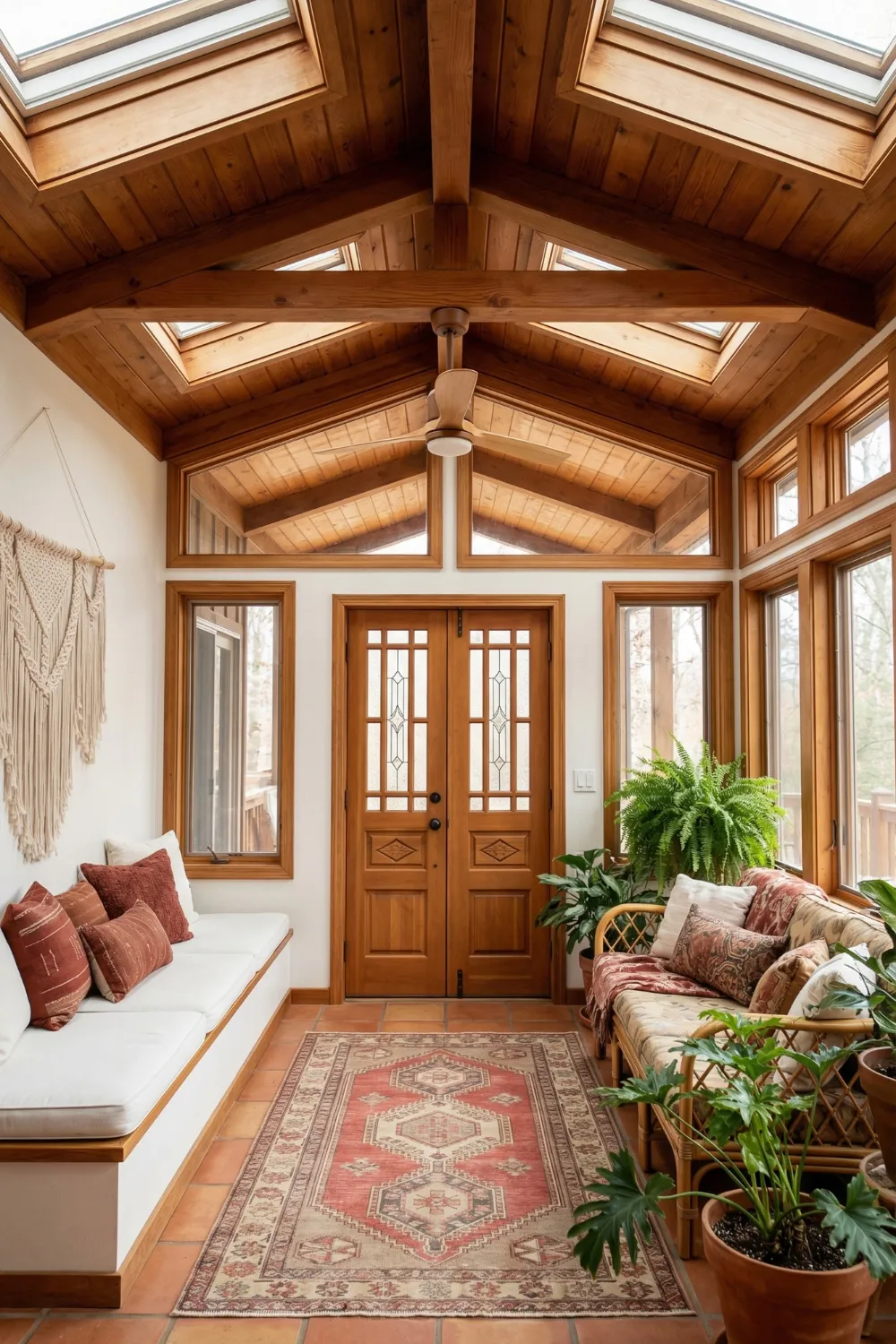
The boho sunroom is the format that most honestly expresses what a sunroom can be at its most successful: a space that people settle into rather than sit in, where the combination of natural materials, warm light, and layered textures creates an environment that actively encourages staying longer than planned.
Material choice in this format is the design language — more important than colour, more important than layout, more important than any specific piece of furniture. Terracotta flooring with its warm undertone and slight surface variation. A wood-panelled ceiling that lowers the overhead plane and creates the coziness of enclosure within a glass-walled space. Layered textiles on every seating surface. Plants treated not as accessories but as architectural elements that guide the eye and define zones.
Building the boho material palette:
- Start with one dominant texture and build outward — terracotta floor as the foundation, then layered textiles, then plants, then ceramic accessories; adding everything simultaneously creates visual chaos rather than the “collected over time” quality that boho style requires
- Patterned rugs in a long sunroom perform an important structural function: they break the room into legible zones and prevent the space from feeling like an undifferentiated corridor with furniture in it
- Colour repetition across different objects and scales (the same terracotta appearing in the floor, a ceramic pot, a pillow accent) creates cohesion without coordination — the colours feel related rather than matched
- Deliberately imperfect arrangements — a plant slightly off-centre, cushions at varying angles, books stacked casually — communicate the ease and authenticity that makes boho spaces feel genuinely welcoming rather than styled
- Deliberately imperfect arrangements — a plant slightly off-centre, cushions at varying angles, books stacked casually — communicate the ease and authenticity that makes boho spaces feel genuinely welcoming rather than styled
9. Bright Entertaining Sunroom Lounge — Zoning as the Structural Principle
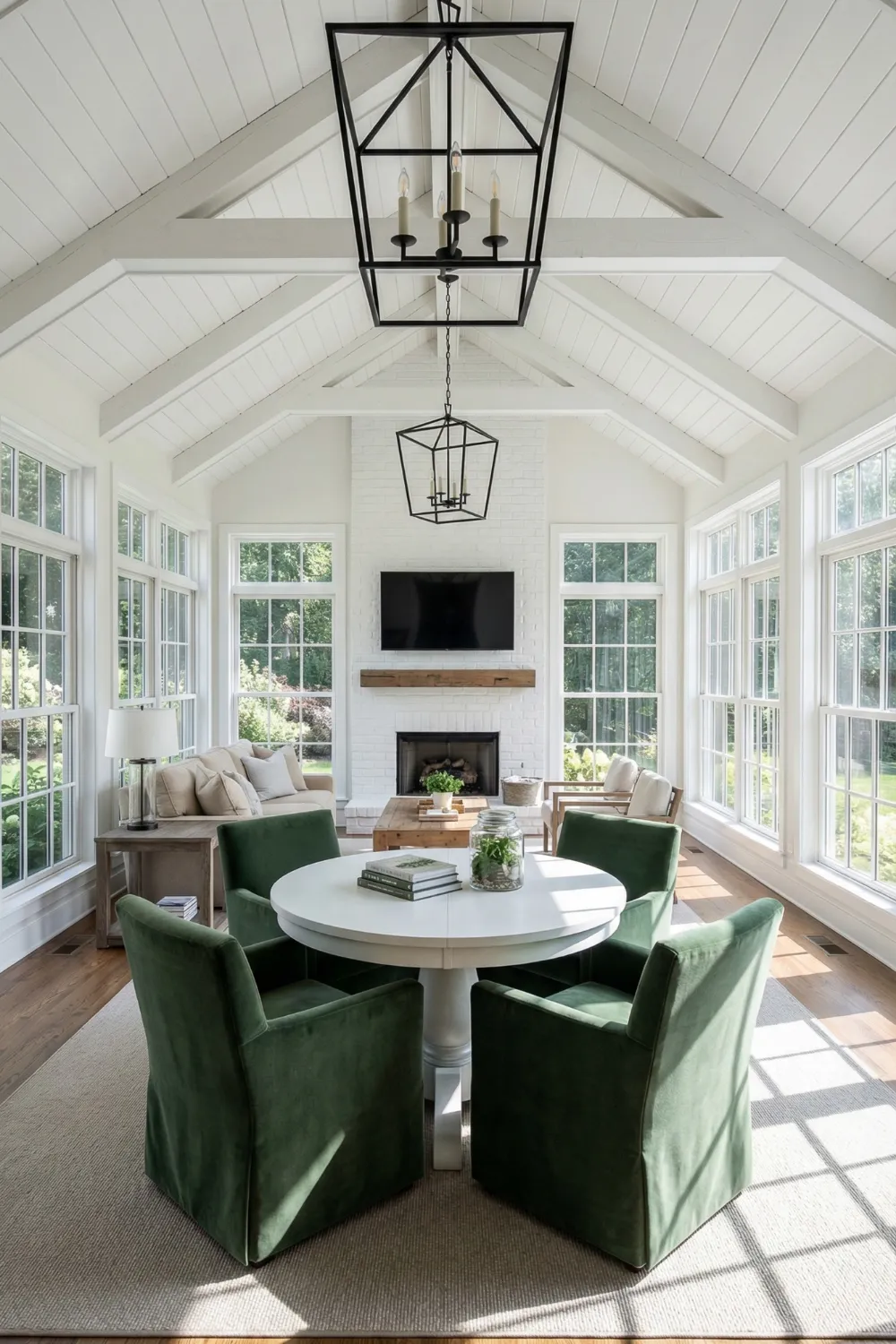
The entertaining sunroom is the format that most directly addresses how groups of people actually use a space together: gathering, dispersing, regrouping, moving between conversation and independent activity. Designing for this behaviour requires thinking about the room as a system of zones rather than a single furniture arrangement.
A central seating grouping around a focal point — in this case, a fireplace — creates the primary social hub. The fireplace does more than provide warmth: it creates a visual anchor that organises the surrounding furniture naturally, gives the eye a landing point that prevents the glass-walled room from feeling directionless, and establishes the room’s emotional register as warm and convivial rather than merely bright.
Designing for social flexibility:
- Consistent window spacing creates the visual rhythm that prevents a glass-heavy room from feeling overwhelming — when structural elements repeat at regular intervals, the eye reads order rather than chaos
- Accent chairs positioned at the edges of the primary seating arrangement allow individuals to join or withdraw from the central conversation without creating awkward furniture choreography
- Lighting scaled to the room’s volume — large pendants or statement floor lamps rather than table lamps alone — maintains the intimate quality of a smaller room despite the generously proportioned space
- Rugs that define the seating zone without cutting off circulation create the spatial definition of separate rooms while maintaining the openness that makes a sunroom feel like a sunroom
10. Casual Coastal Sunroom Seating — Discipline Within Relaxation
The coastal sunroom is the format most commonly executed without sufficient design discipline — the category that most readily drifts into beach house cliché, where every surface accumulates shells and nautical rope until the room reads as a theme rather than a home. The version that works applies the same restraint to coastal references that all successful themed design requires: the theme should be felt rather than stated.
The palette discipline is what makes this format succeed or fail. Committing to a limited colour range — warm neutrals, natural rattan, one or two accent colours drawn from the view beyond the windows — and then resisting every subsequent impulse to add more establishes the visual calm that makes coastal design feel relaxed rather than cluttered. The striped ottoman provides the one pattern statement the room needs; everything else is textural rather than patterned.
The “less addition, more editing” approach:
- Natural rattan seating is the material that delivers the most coastal character per square foot of visual space — its texture, colour, and lightness all communicate warmth and ease simultaneously
- Brick and stone architectural elements (a fireplace surround, a feature wall) provide the grounding that prevents the room from feeling insubstantial despite its light palette and airy materials
- A bold striped textile at the room’s centre (the ottoman, the central rug) provides the pattern statement that keeps the restrained palette from reading as bland, while the neutrality of everything surrounding it gives the pattern space to register properly
- Minimal accessories positioned deliberately at clear visual points — rather than distributed across every surface — maintain the clarity of sightlines that makes the sunroom feel open and the view beyond it feel like the



Pingback: Moody Living Room Ideas That Feel Cozy, Not Claustrophobic - Decorly Nest | Modern Home Decor Ideas