
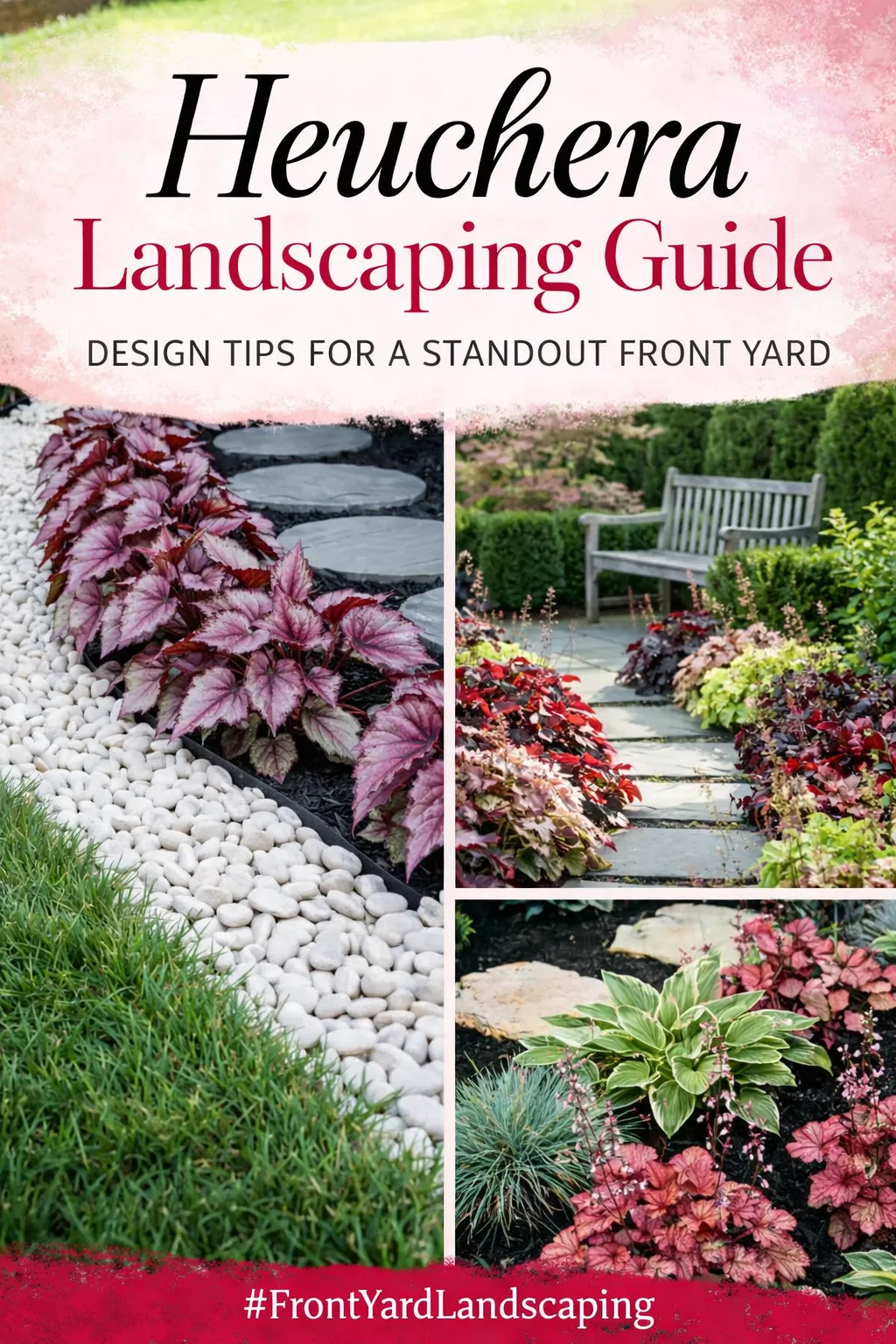
One Plant, a Dozen Possibilities — Why Coral Bells Belong in Every Front Yard
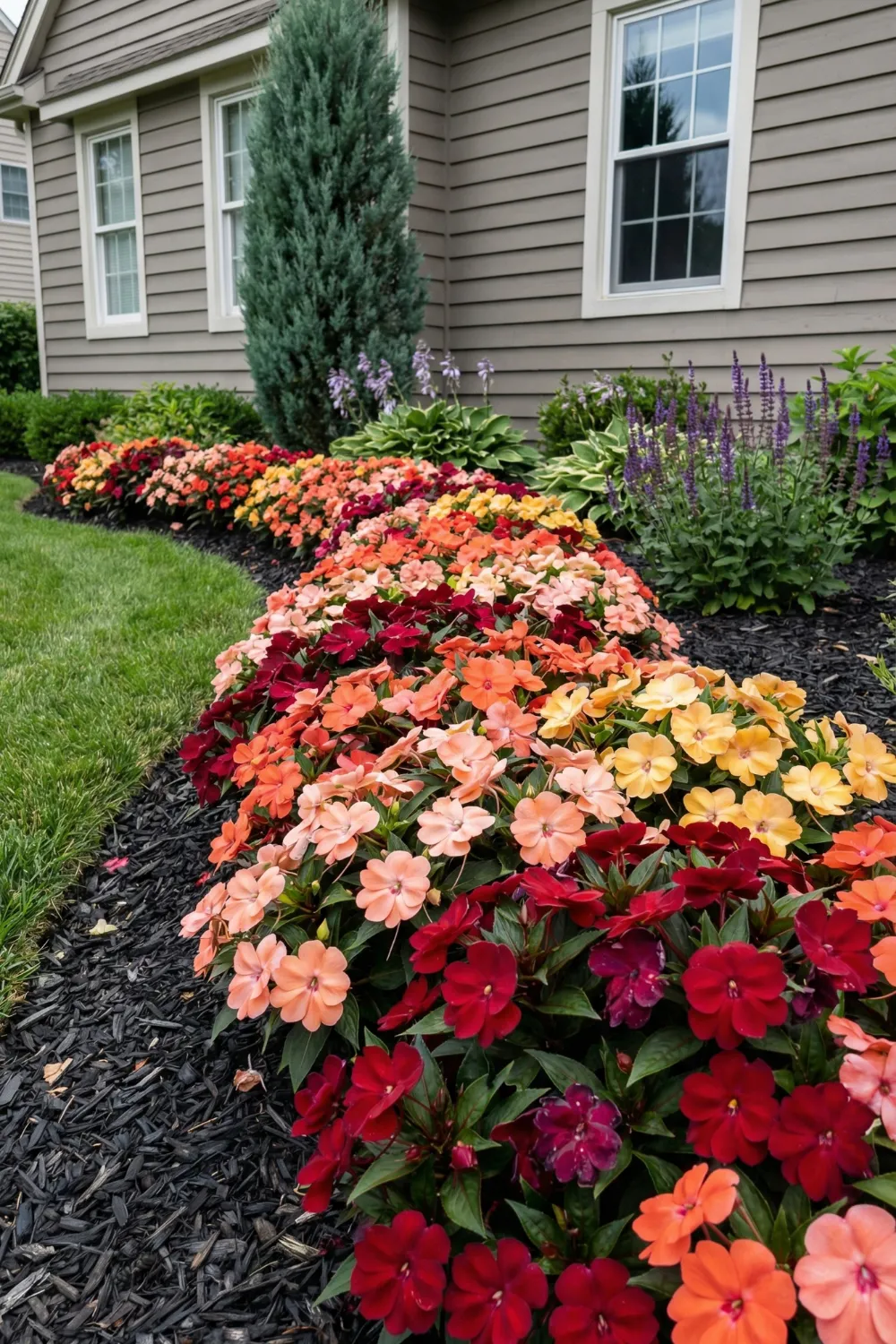
Walk down any neighborhood street and the front yards start blending together after a while. Mulch, boxwoods, a few hostas, maybe a lone ornamental grass by the mailbox. It is not that these choices are bad — they are just predictable. And predictable rarely makes a front yard memorable.
Heuchera, commonly sold as coral bells, is one of the few plants that can break that pattern without requiring a redesign, a contractor, or a weekend of hard labor. It is compact, colorful, shade-tolerant, deer-resistant in most regions, and available in a foliage range that goes from deep wine burgundy to electric lime green to soft peachy apricot. The variety is genuinely unusual for a perennial this low-maintenance.
What makes heuchera worth an entire conversation on design, though, is not just the plant itself. It is how well it responds to intentional placement. Tucked against stone, layered with hostas, used to line a curved path — the same plant reads completely differently depending on how it is used. This guide covers both the design principles and the practical how-to details so you can put coral bells to work in your specific front yard, not just admire them in someone else’s.
Heuchera 101: What You Need to Know Before You Plant
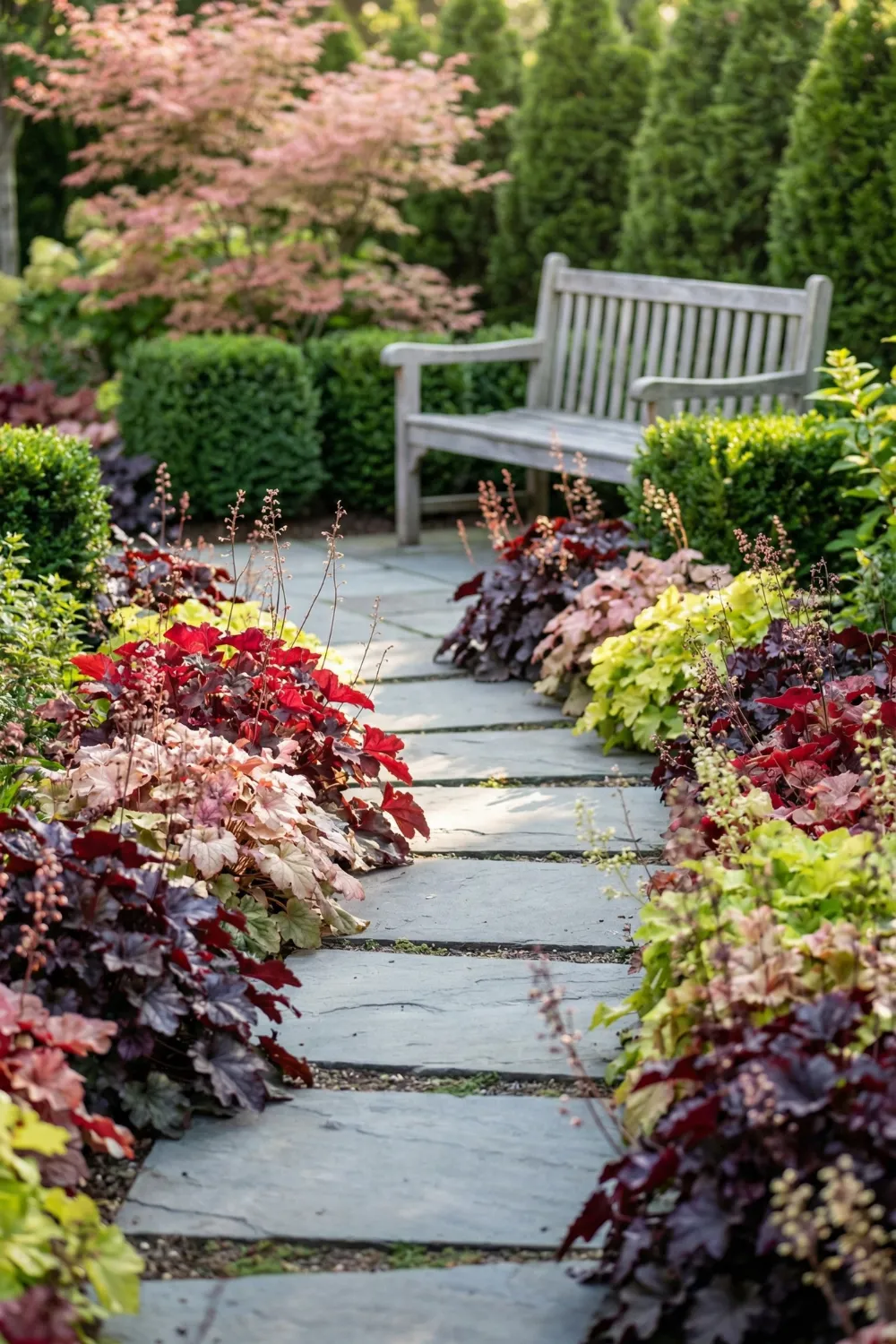
Before diving into design, a few grounding facts help you choose the right variety and avoid the most common planting mistakes.
Light requirements:
Heuchera is often labeled a shade plant, which is accurate but incomplete. Most varieties perform best in partial shade — meaning two to four hours of direct sun per day with bright indirect light the rest of the time. In hot climates (USDA zones 7 and above), afternoon shade is essential or the leaves will bleach and scorch. In cooler northern climates, heuchera handles more sun without stress.
Soil and drainage:
The fastest way to kill heuchera is wet, compacted soil. These plants need well-draining ground with good organic content. Amend clay-heavy soil with compost and coarse grit before planting. Raised beds and sloped areas work naturally well.
Size:
Most heuchera varieties stay between 12 and 18 inches tall with a spread of similar width. Flower stalks add another 12 to 24 inches of airy height above the foliage in late spring to early summer.
Hardiness:
Most varieties are reliably hardy in zones 4 through 9. They are semi-evergreen in mild climates and may die back to the crown in colder winters, returning reliably in spring.
Maintenance:
Minimal. Remove spent flower stalks after bloom. Divide clumps every three to four years when the center becomes woody and growth slows. Refresh the planting hole with compost at division time.
Landscape Design Principles: Designing With Intention, Not Just Plants
Let Coral Bells Bridge the Gap Between Hardscape and Softscape
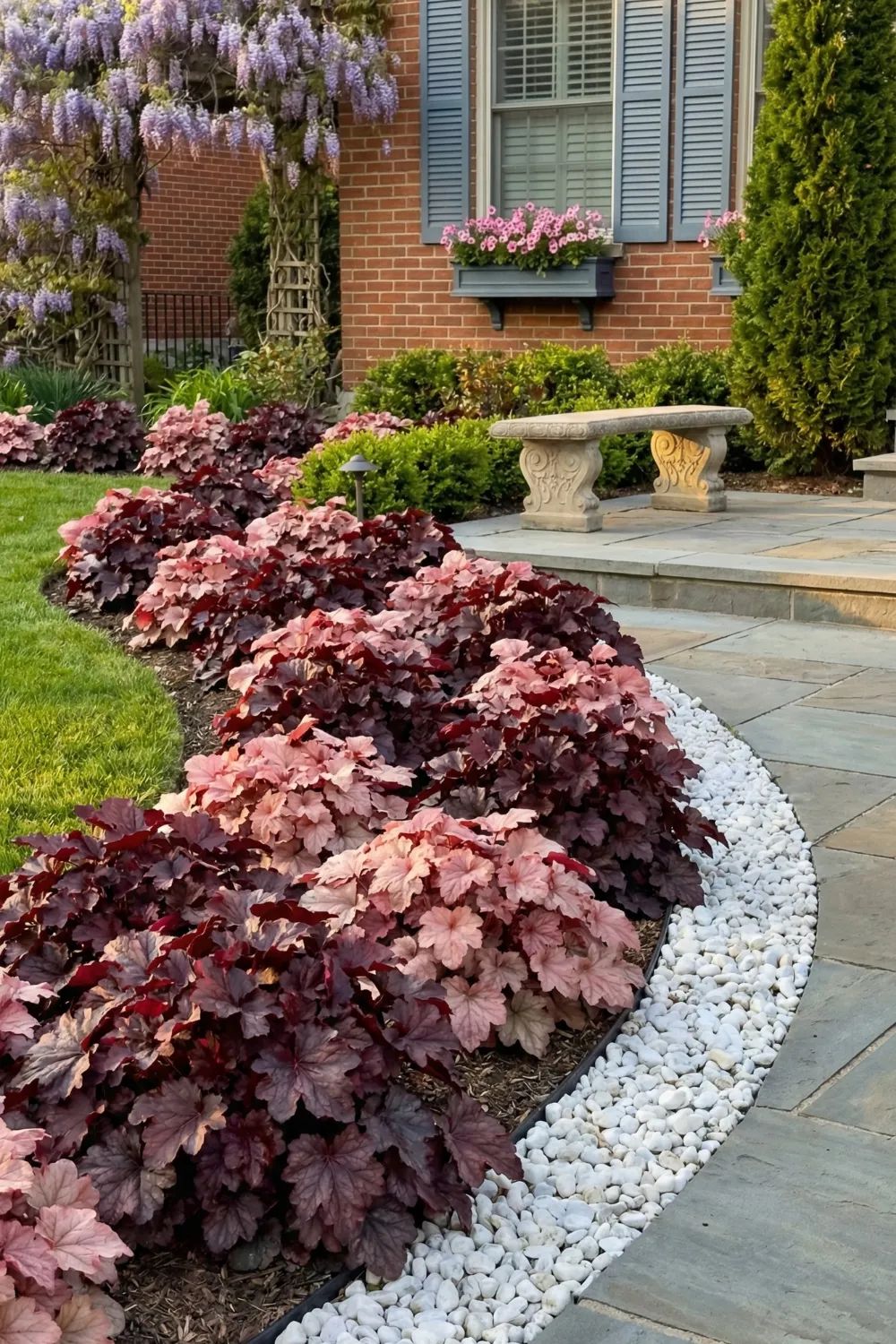
One of the most common visual problems in front yard landscaping is the hard stop between paving and planting. A clean stone path or concrete walkway runs right up to a bed edge with nothing softening the transition. The result looks assembled rather than designed.
Heuchera handles this transition better than almost anything else at its size. The rounded, ruffled foliage spills gently over hard edges without becoming invasive or messy. Planted 6 to 8 inches back from a pathway edge, the leaves arch outward and visually connect the stone to the planting bed behind it.
How to recreate this: Plant heuchera along both sides of a stone or paver path, 6 inches from the edge. Mix two varieties — a darker purple or burgundy on one side and a lighter caramel or peach on the other. The contrast keeps both varieties visible without either one reading as a mistake.
Line Your Stone Paths With a Ripple-Effect Border
Repetition is one of the most powerful and underused tools in residential landscape design. Planting the same varieties at regular intervals along a path creates visual rhythm — a pattern the eye follows without conscious effort, which makes the whole garden feel more organized and intentional.
Spacing for this effect: Plant individual heucheras 14 to 16 inches apart (center to center) for a continuous border look. At this spacing, they will touch and blend together in the second season, creating a seamless edge. For a more defined, spaced look, go 20 inches apart and mulch the gaps.
Layer Heights for Natural Vertical Movement
A flat garden bed — one where everything is roughly the same height — reads as a carpet rather than a landscape. The fix is layering, and heuchera fills the lowest tier of a three-layer planting scheme better than almost any other perennial.
Specific plant combinations that work:
- Background: Arborvitae, dwarf viburnum, or ornamental grasses above 3 feet
- Mid-layer: Astilbe, coneflower, or compact hydrangea
- Foreground: Heuchera, creeping sedum, or ajuga
Balance Fine-Leaved Coral Bells With Coarse-Textured Companions
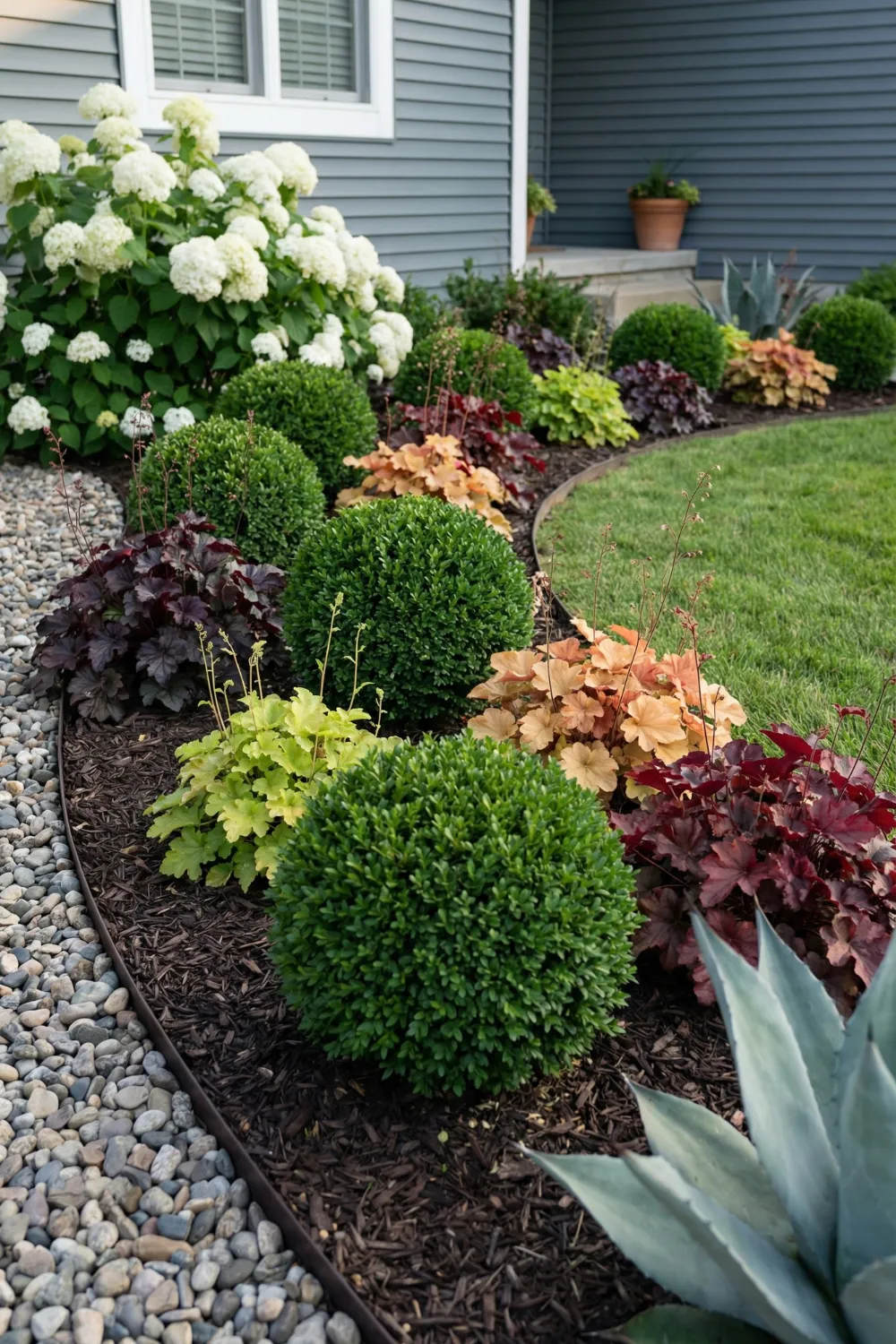
Texture contrast is the design principle that separates a planting bed that looks professionally designed from one that just looks full. Heuchera has fine, ruffled, detailed leaf texture. Its natural pairing partner is hosta, which has large, smooth, paddle-shaped leaves. Planted together, each makes the other look better.
Other coarse-texture companions for heuchera:
- Elephant ears (Colocasia) in warm climates
- Large-leaved sedum varieties
- Bergenia (pig squeak)
- Ornamental kale as a seasonal addition
Repeat Coral Bells as Echo Plants to Build Visual Rhythm
When the same heuchera variety appears in multiple locations — at the base of the mailbox post, in the border by the front steps, and in a container on the porch — the plant becomes a recurring design element that ties the whole yard together. This technique is called echo planting.
Practical tip: Choose one heuchera variety to be your echo plant — pick one with a distinctive, visible color that reads well from the street. Plant it in at least three separate locations in the front yard. The repetition does not need to be obvious or symmetrical.
Highlight Their Color With a Backdrop of Light Gravel or Stone
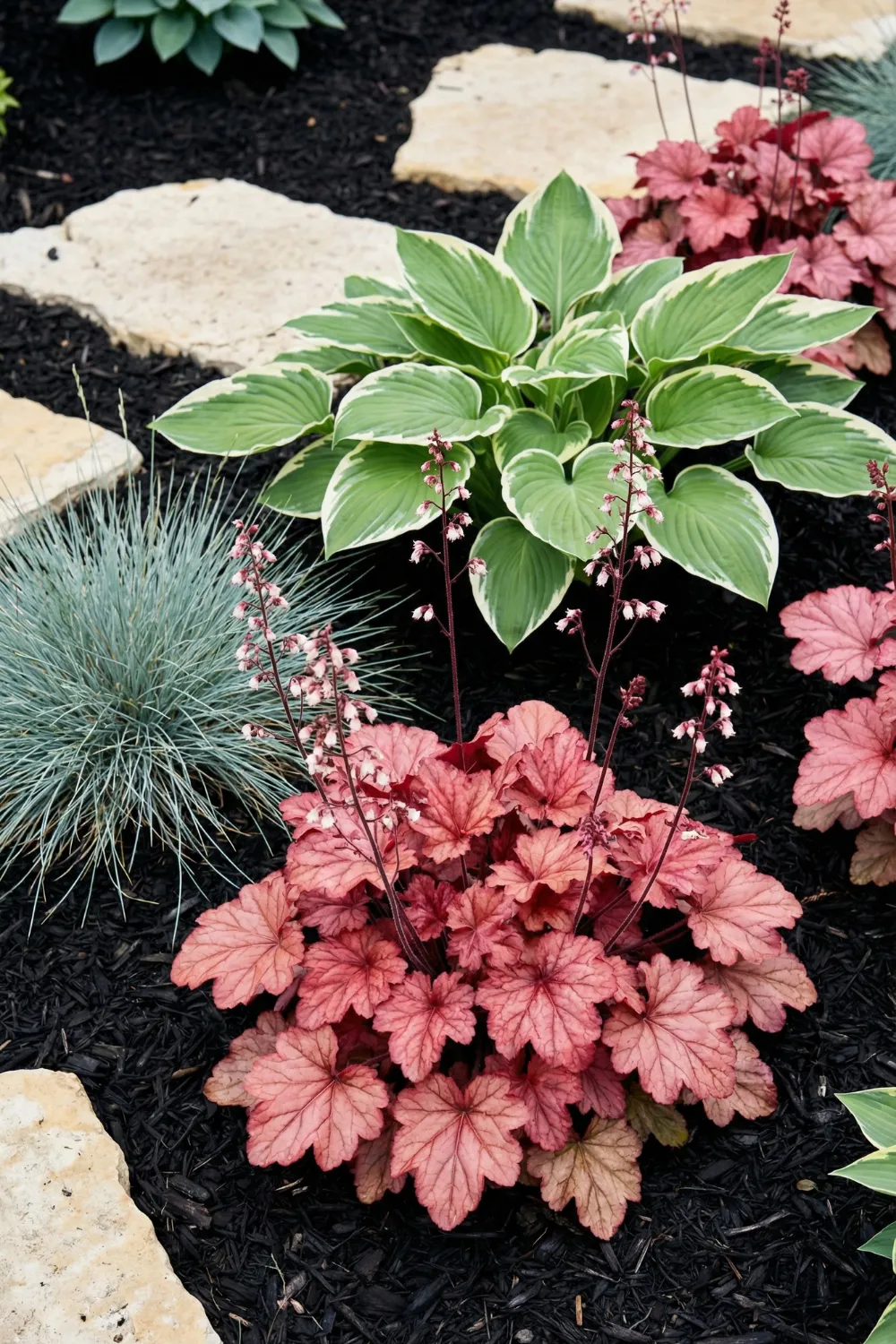
Foliage color needs contrast to register fully from a distance. Deep burgundy heuchera planted against dark mulch disappears visually. The same variety planted against light river rock or pale crushed gravel glows.
Mulch and gravel options by heuchera color:
- Deep burgundy and plum: Light gray gravel, pale limestone chips, white marble mulch
- Caramel and peach: Medium brown bark mulch, tan pea gravel
- Lime green and chartreuse: Rich dark brown mulch, black lava rock
- Silver and pewter: Any mulch works, but white stone creates a crisp modern contrast
Plant in Soft Curves, Not Straight Rows
Straight-line planting beds feel institutional — like the landscape was planned with a ruler rather than designed with any feel for how a garden should flow. Curved beds are more inviting, more organic, and more visually dynamic.
The garden hose method: Before digging, lay a garden hose on the ground in the curve you want to create. Step back and look from the street. Adjust the hose until the curve reads well from that distance. Once satisfied, mark along the hose with flour or marking paint, then dig.
Color Psychology: Why Foliage Tones Matter More Than You Think
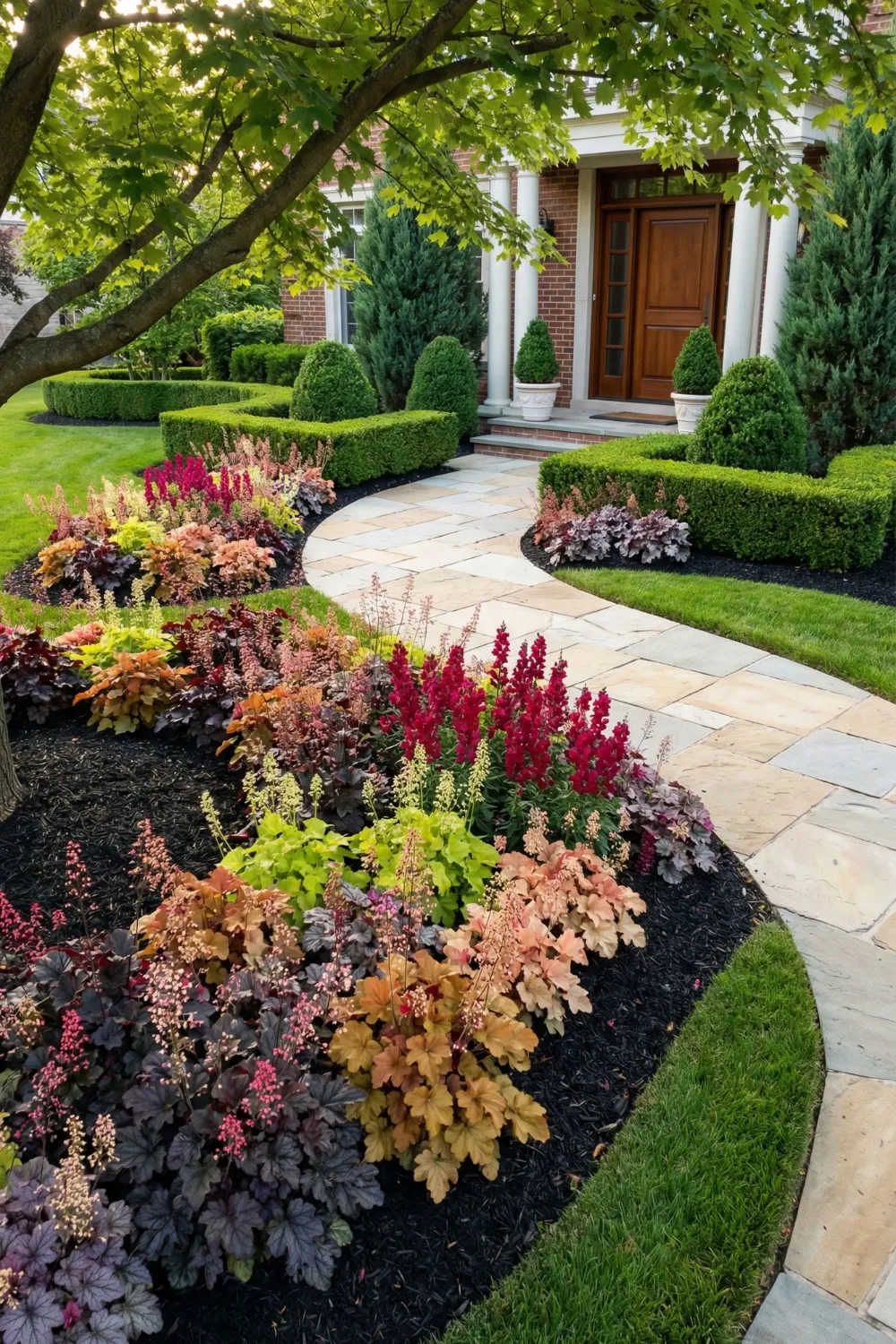
Peachy Foliage for a Welcoming First Impression
Warm tones — peach, apricot, terracotta, caramel — are the most hospitable colors in a garden palette. They register as friendly and approachable, which is exactly what a front yard is supposed to communicate. If your front entry is formal or your house exterior is cool-toned, peachy heuchera at the base of the entry steps softens that formality.
Best variety examples: ‘Caramel,’ ‘Georgia Peach,’ ‘Delta Dawn’
Pairing tip: Coordinate peach foliage with a front door color in terracotta, rust, or sage green for a cohesive entry palette.
Burgundy Hues Add a Touch of Timeless Sophistication
Deep burgundy and wine-red heuchera varieties have a richness that reads as intentional and sophisticated at the street level. They pair naturally with traditional materials — brick, stone, dark wood trim — and reinforce the established character of older architectural styles.
Best variety examples: ‘Palace Purple,’ ‘Obsidian,’ ‘Blackberry Jam’
Pairing tip: Against brick facades, choose the deepest burgundy varieties. The contrast between warm brick and cool-dark foliage creates more visual interest than a close-in-tone red would.
Lime Green Foliage Sparks Instant Energy and Freshness
Chartreuse and lime green heuchera is the highest-contrast foliage option in the genus. Planted under a tree or beside a north-facing wall, lime green foliage reflects enough light to make the whole area feel brighter. It also modernizes a traditional home when paired with a neutral gray or white exterior.
Best variety examples: ‘Lime Rickey,’ ‘Electric Lime,’ ‘Key Lime Pie’
One caution: Lime green heuchera can look jarring if the rest of the planting palette is very dark or cool. Balance it with warm-toned companions such as orange rudbeckia or golden creeping Jenny.
Selecting Varieties: A Practical Guide to What’s Actually Available
For deep shade (less than 2 hours of direct sun):
- ‘Obsidian’ — near-black foliage, very tolerant of low light
- ‘Caramel’ — warm amber, unexpectedly good in shade
- ‘Midnight Rose’ — dark purple with pink speckle
For hot, dry summers (zones 7–9):
- ‘Rio’ series — heat and humidity tolerant
- ‘Carnival’ series — developed for southern gardens
- Any Heucherella hybrid — tend to be more heat resilient
For maximum color impact from the street:
- ‘Electric Lime’ — the brightest green available
- ‘Fire Alarm’ — vivid true red, holds color through summer
- ‘Peach Flambe’ — warm orange-red that brightens in fall
For container planting on porches or steps:
- ‘Dolce’ series — compact, 10 to 12 inches, excellent container performance
- ‘Marmalade’ — unusual orange-toffee tones, distinctive and contained
A Front Yard That Feels Intentional, Emotional, and Effortless
The reason heuchera keeps appearing on design-forward garden lists is not the plant itself in isolation — it is the design flexibility. Very few perennials give you this many foliage colors, perform well in this range of light conditions, require this little maintenance, and respond this well to deliberate design placement.
The front yard work happens at two levels simultaneously. At the practical level, you are filling a planting bed with something that actually grows, holds its color, and comes back every year. At the design level, you are using foliage color, texture contrast, rhythmic repetition, and height layering to create a yard that reads as considered rather than assembled.
Put those two things together — a plant that performs reliably and a set of design principles that work — and the results surprise people. Not because heuchera is exotic or complicated, but because most front yards are not designed with this kind of intention. Yours will be.
Note: Heuchera hardiness varies by variety. Check the USDA Plant Hardiness Zone Map for your specific region before purchasing. Most varieties perform best in zones 4–9.

Pingback: 15 Front Porch Planters That Make Your Home Look Expensive - Decorly Nest | Modern Home Decor Ideas
Pingback: 12 Full Sun Perennials That Thrive on Neglect (Perfect for Lazy Gardeners) - Decorly Nest | Modern Home Decor Ideas