
How Designers Are Really Thinking About Indoor Pool Spaces Right Now
I remember the first time I went into a house that had a really nice indoor pool. It wasn’t as grand as you might think. It was quiet and warm, and it felt more like a Kyoto spa than a room attached to the back of a suburban house.
That moment stuck with me because it proved something I’ve always believed: when done right, indoor pool spaces are some of the most life-changing rooms a home can have. But for a long time, most indoor pools looked the same. Tiles that are white. Bright lights above. A couple of plastic loungers. The kind of space you’d walk through with wet feet and no desire to stay. To be honest? A very big missed chance. But that’s not the case anymore.
From what I’ve seen on design projects in 2024 and 2025, home owners and designers are really changing how they think about designing indoor pools. It’s no longer just a “functional room with water in it.” Instead, it’s a fully designed space where architecture, lighting, materials, and mood all work together to create a single experience. Top interior designers say that the indoor pool is no longer a luxury. It’s becoming the home’s emotional center.
Here’s what that actually looks like in practice.
The Warm Minimalist Spa Pool — Where Less Actually Delivers More
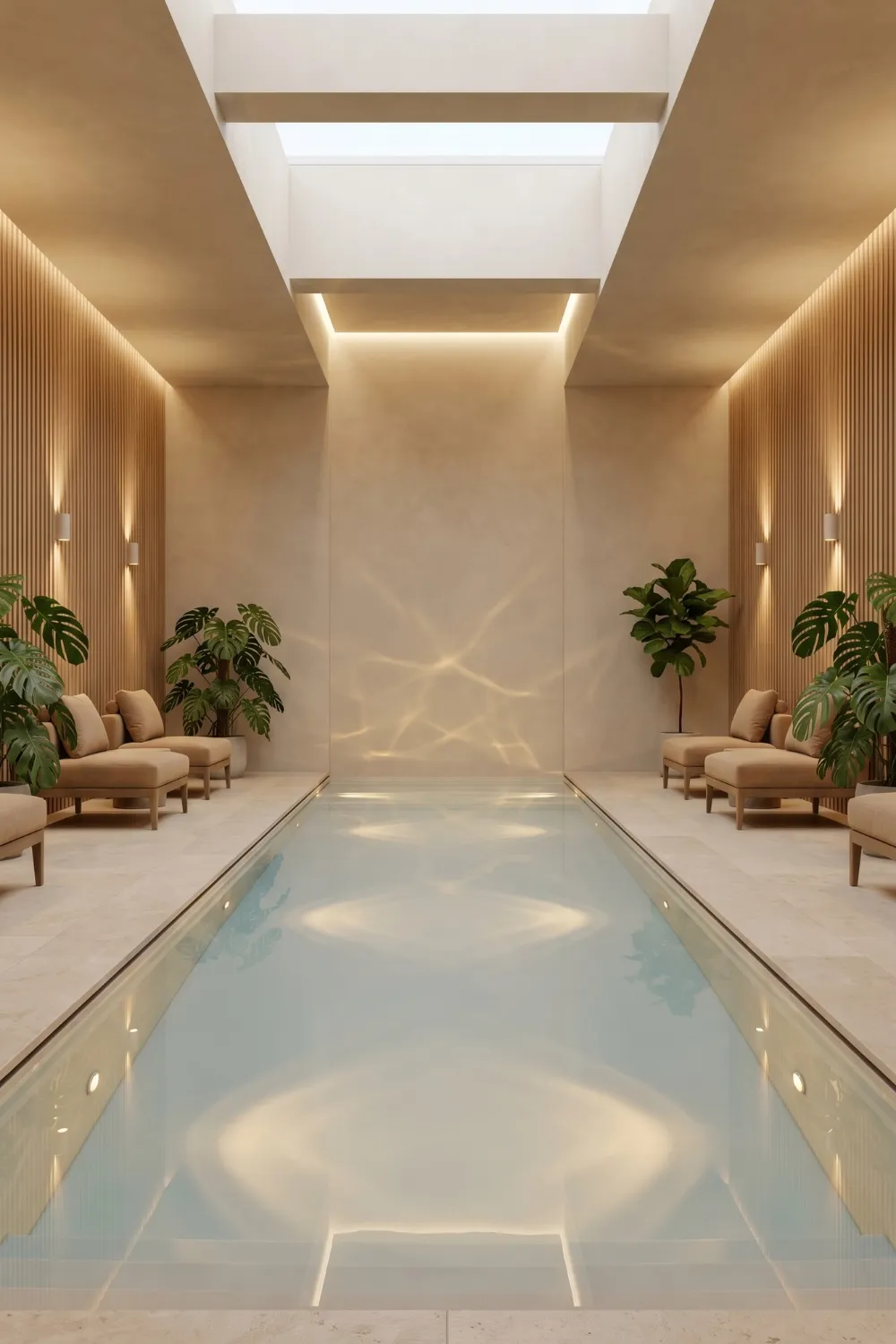
Here’s the thing about minimalism — it only works when every single element that stays in the room is doing serious work. And this warm spa-style pool concept is a masterclass in exactly that.
The pool itself is a clean rectangle. Simple. But what makes the space feel genuinely expensive isn’t the size or the stone — it’s the lighting strategy. We’re looking at three distinct lighting layers here: recessed ceiling glow, soft wall washes, and subtle spotlights placed just below the waterline. Indirect lighting always feels more luxurious than direct lighting. It softens everything, smooths out surfaces, and creates the kind of atmosphere you associate with places that charge a lot per night.
Vertical wood slats run along the walls, adding rhythm and visual warmth without adding visual clutter. The material palette is deliberately tight — warm wood tones, soft beige upholstery, muted stone tiles. Three materials, maybe four. That’s it. And it works because restraint is doing the designing.
Seating is symmetrical, which immediately gives the room a balanced, considered feeling. Large plants are placed for scale, not just decoration. And I’d argue the plants are load-bearing in this design — they soften the hard geometry in a way no cushion or rug ever could.
My take: If you’re recreating this look, start with your lighting plan before you touch a single tile. The lighting is the design here. Everything else is just support.
→ More minimalist home design ideas
The Tropical Cave Pool — Biophilic Design at Its Most Committed
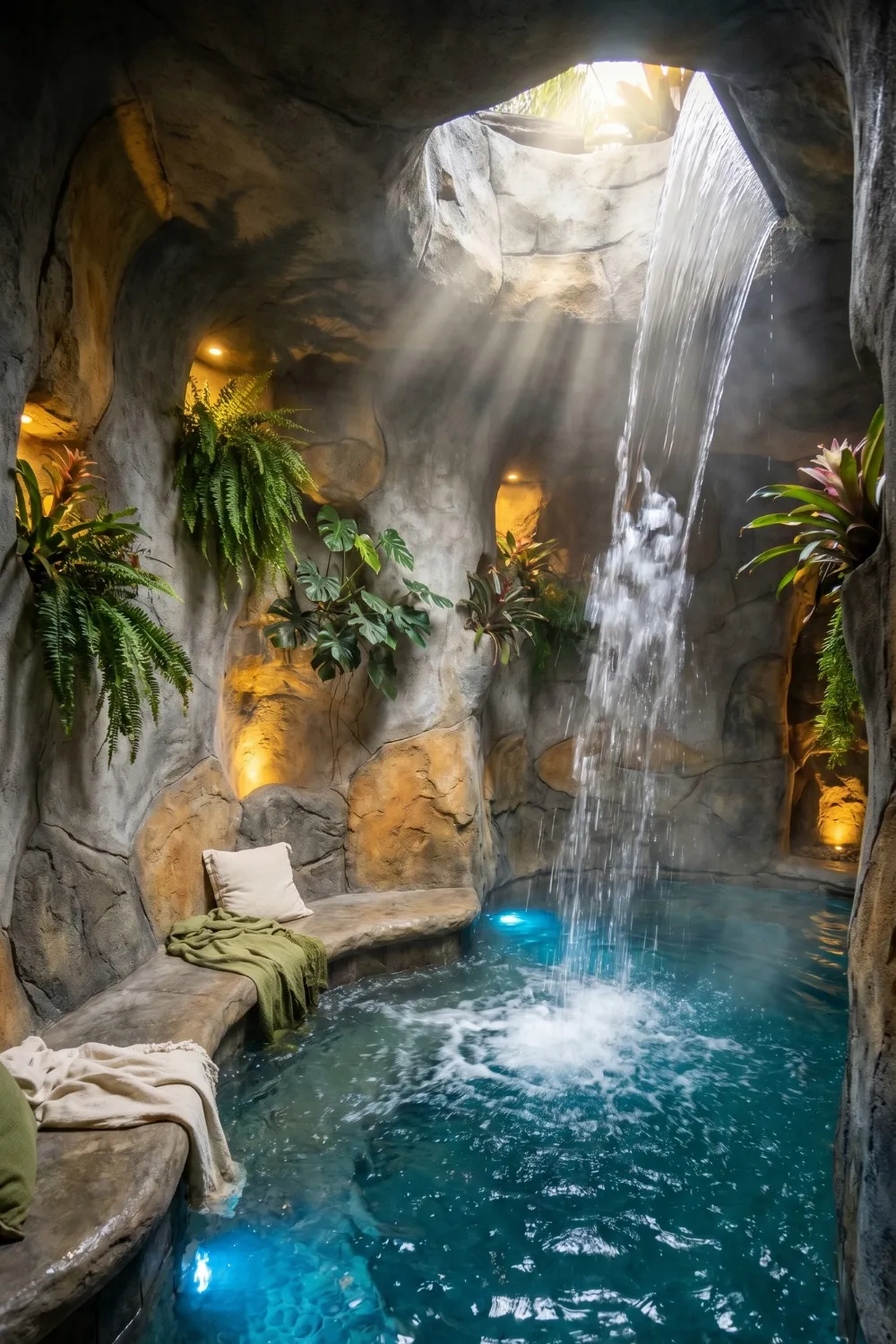
Some designs are restrained. This one is not, and it’s better for it.
The cave pool concept flips everything you expect from an indoor pool on its head. Forget straight lines and smooth surfaces. Here, everything is curved, textured, slightly unpredictable. The ceiling rises and dips organically. The walls have the kind of tactile irregularity you’d find in a natural rock formation. And right at one end, a waterfall drops into the pool — not as a decorative afterthought, but as a fully functional focal point that creates movement, ambient sound, and a visual anchor all at once.
This is biophilic design pushed to its natural conclusion: bringing the outside in so convincingly that you genuinely forget you’re inside a building.
But here’s what I think people miss when they look at this kind of space — you don’t need a literal cave to achieve this effect. Textured plaster, limewash walls, and faux rock paneling can all mimic that organic irregularity without requiring a structural overhaul. The real magic is in the texture. Smooth walls would kill this design instantly.
The seating is built-in and curved, following the architecture naturally. Soft textiles — throws, cushions in earthy tones — are mixed against the stone to keep things from feeling cold or cavernous. Mixing hard and soft materials is what stops this from tipping into “cave-core chaos.”
→ Explore biophilic interior design for homes
The Sunlit Conservatory Pool — When Natural Light Does All the Heavy Lifting
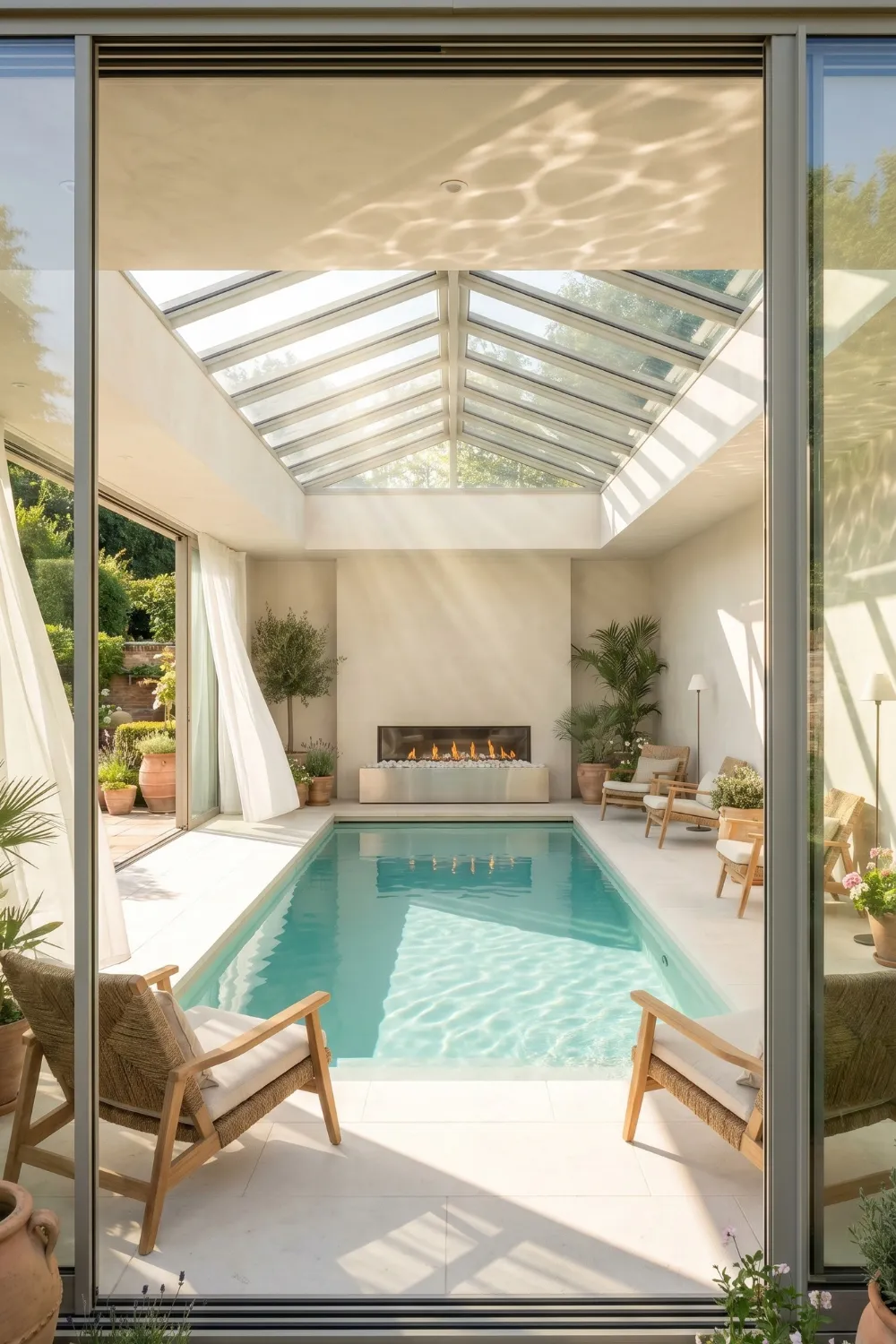
Natural light is, without question, the most underused and undervalued design tool in any interior space. And this conservatory-style pool is basically a love letter to what happens when you let it do its job.
The glass roof floods the space with daylight at every hour, making the pool feel larger, more alive, and naturally energized. Large glass doors blur the line between the indoor pool and the garden beyond — which isn’t just beautiful, it’s spatially intelligent. Visual continuity with outdoor nature makes enclosed spaces feel open, even expansive.
The furniture here leans relaxed and patio-like. Woven textures, light wood frames, neutral cushions. Nothing overly polished. It creates the kind of space you’d actually use daily, not just on special occasions.
And then there’s the fireplace. Adding a fireplace to a pool space might sound counterintuitive, but it creates a year-round usability that most indoor pools lack. The contrast of warm fire and cool water is deeply satisfying — it’s the same logic as a Finnish sauna with a cold plunge. Your nervous system loves that contrast, and apparently, so does every design instinct I have.
What I’d recommend: If full glass roofing isn’t possible, even one or two well-placed skylights can transform how natural light moves through a pool space. It’s worth the investment before almost anything else.
→ More conservatory & sunroom design ideas
The Rustic Modern Pool — Cabin Energy Meets Architectural Ambition
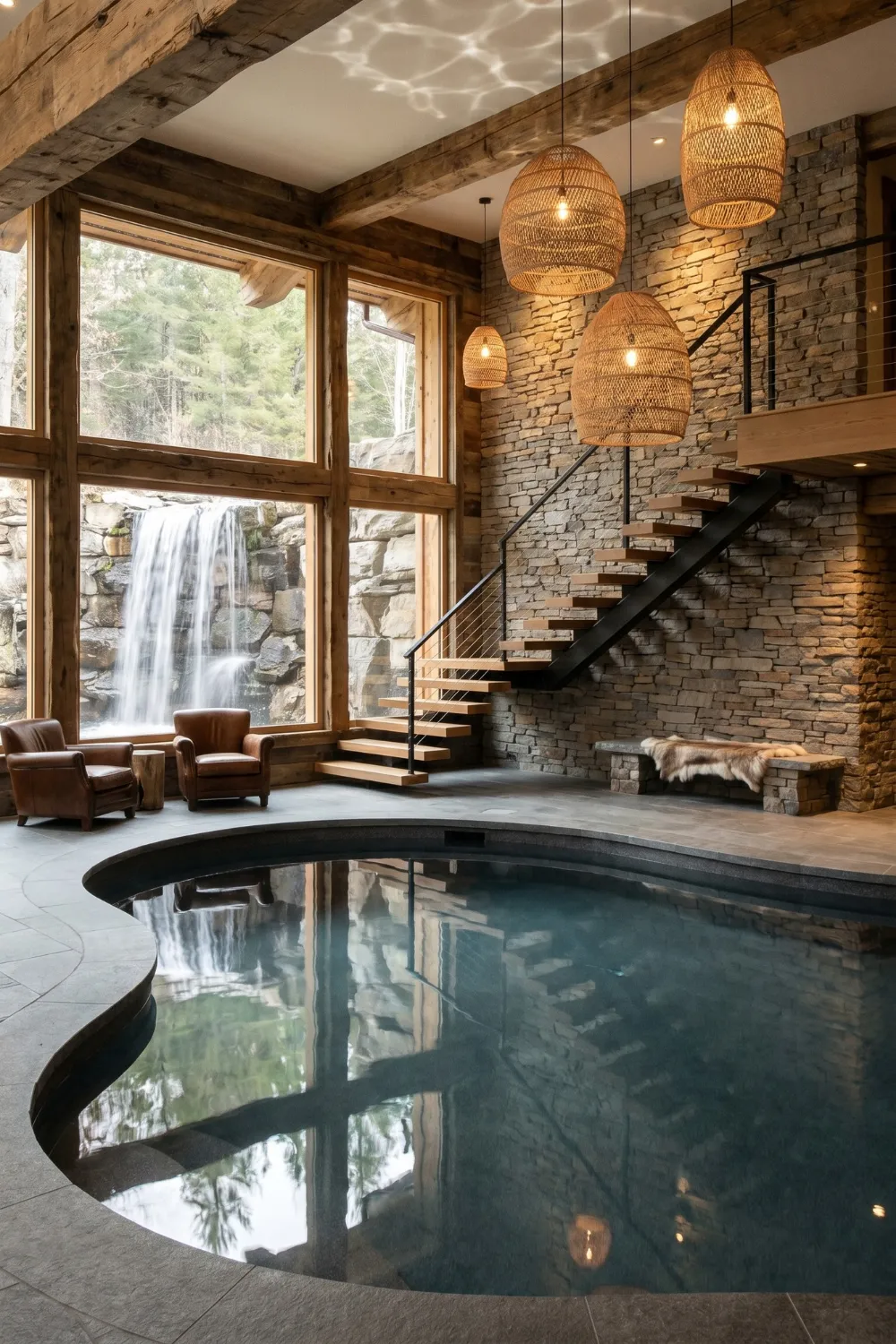
This design proves you can build a space that feels both rugged and refined. Exposed wood beams, rough stone walls, and massive picture windows come together in a way that should feel heavy — but somehow doesn’t, because the windows let light in from every angle.
The standout move here is what’s outside those windows: a natural waterfall. It becomes a living artwork that changes with the light, the season, the weather. You don’t need a waterfall on your property to pull this off — a water feature, a carefully layered garden, or even a moss wall can give the eye somewhere to travel beyond the pool. Depth equals luxury. That’s not a design theory, that’s just how human perception works.
The floating staircase and double-height ceiling add vertical interest that indoor pool design almost always ignores. I’ve seen so many pool spaces that were designed entirely at eye level, with no thought given to what happens above the water. Don’t make that mistake. Pendant lights, hanging planters, and dramatic ceiling treatments activate vertical space and make a room feel custom-built rather than assembled.
The Resort-Style Pool With Lounge Fire Pit — Because Zoning Changes Everything
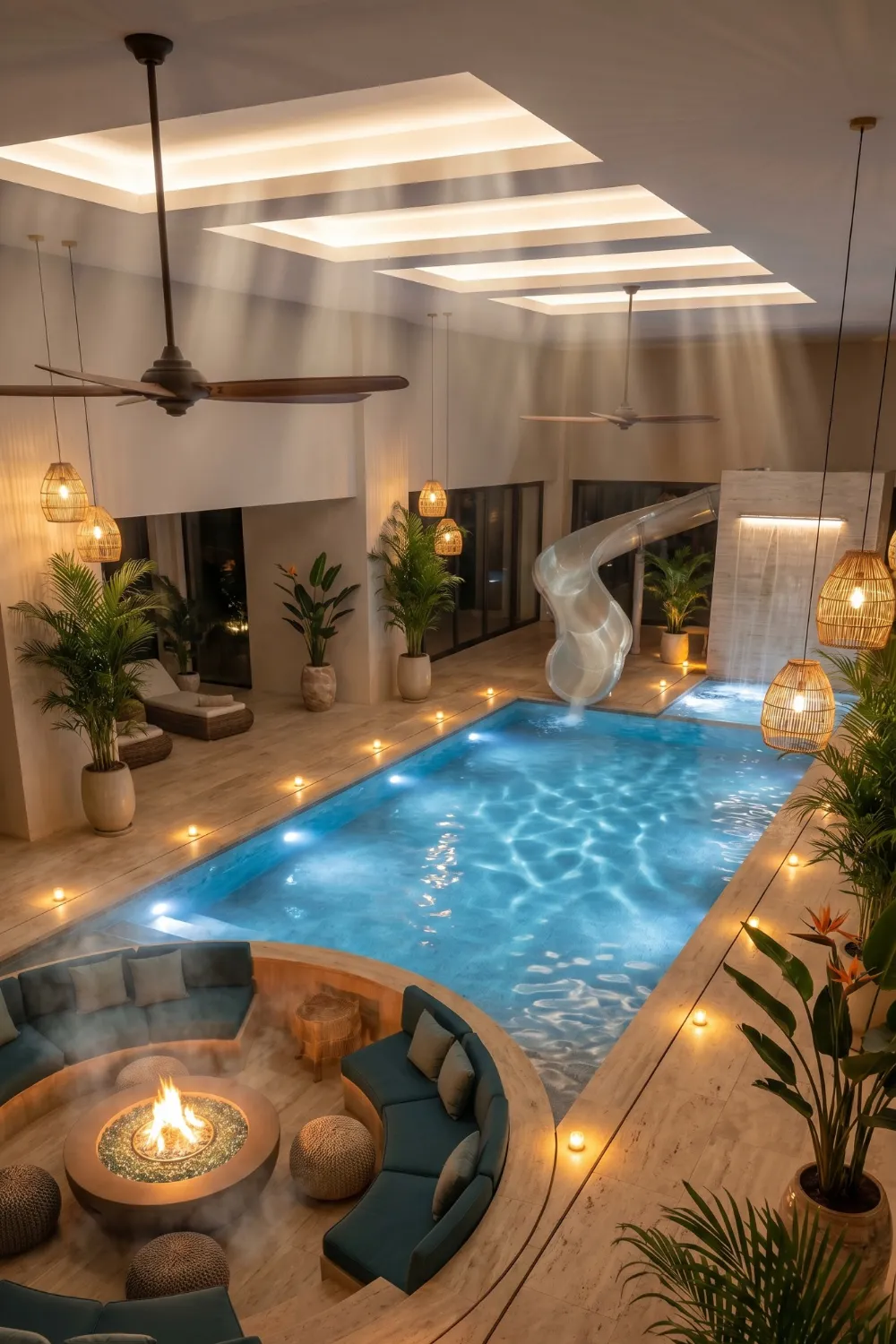
This isn’t just a pool design. It’s a full spatial strategy.
What makes this space work isn’t the palm elements or the dramatic ceiling height — though those help. It’s the zoning. The space is divided into clear, purposeful areas: swimming, lounging, socializing. And crucially, those zones are defined without walls. You get the openness of one large room with the functionality of three distinct spaces.
The fire pit seating area is the anchor. It creates a social zone that draws people in even when nobody’s swimming. Every pool space needs a focal gathering point that isn’t the water itself. A fire feature, a statement sofa arrangement, even an oversized coffee table — something that says “this is where we hang out.”
Lighting and decor play into the tropical resort theme without going overboard. Lanterns, warm ambient light, natural textures. The slide and waterfall add playfulness, which is honestly something a lot of “serious” design spaces are afraid of. But a space you can laugh in is a space you’ll actually want to use.
→ More indoor/outdoor entertainment space ideas
The Lush Tropical Lounge Pool — Greenery as Architecture
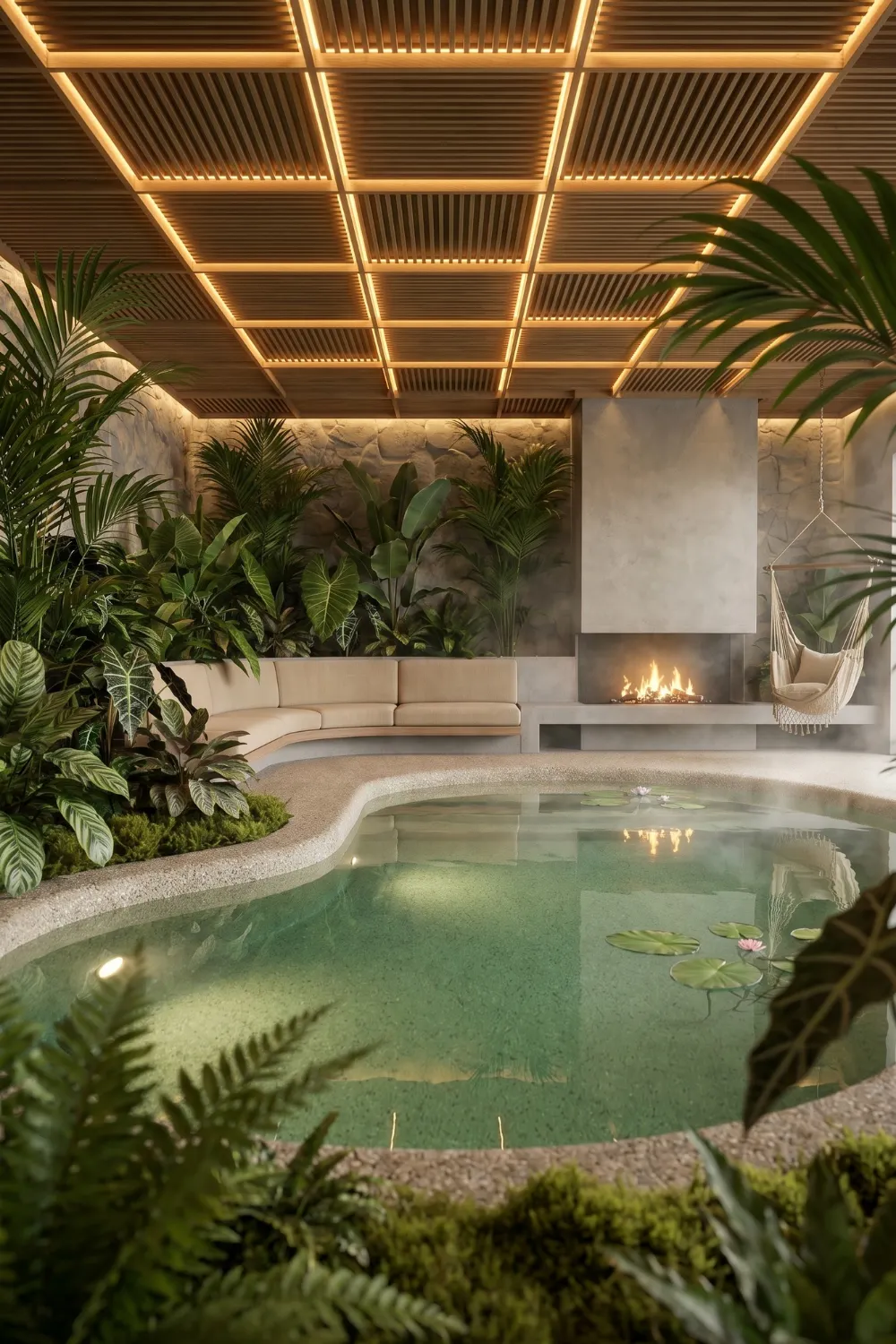
Here’s a design principle I keep coming back to: greenery, when layered intentionally, functions like architecture. It creates depth, defines zones, and adds visual complexity in a way that furniture simply can’t replicate.
This pool space understands that completely. Tall palms at the back, mid-height plants filling the middle ground, and low greenery framing the pool edge. The result is a layered backdrop that makes the pool feel like it’s set within a landscape, not just placed in a room.
The rest of the design is deliberately calm — beige seating, soft stone floors, warm ambient lighting. The neutrality is strategic. It lets the greenery pop without competing. Low-profile, curved furniture keeps the vibe relaxed and easy.
And then the built-in fireplace introduces fire alongside all that water and green. The contrast is spa-level luxurious. If you’re building a tropical pool lounge, don’t skip this kind of contrast — it’s what separates a beautiful room from an unforgettable one.
The Glass Roof Lap Pool With Indoor Jungle — Function Meets Atmosphere
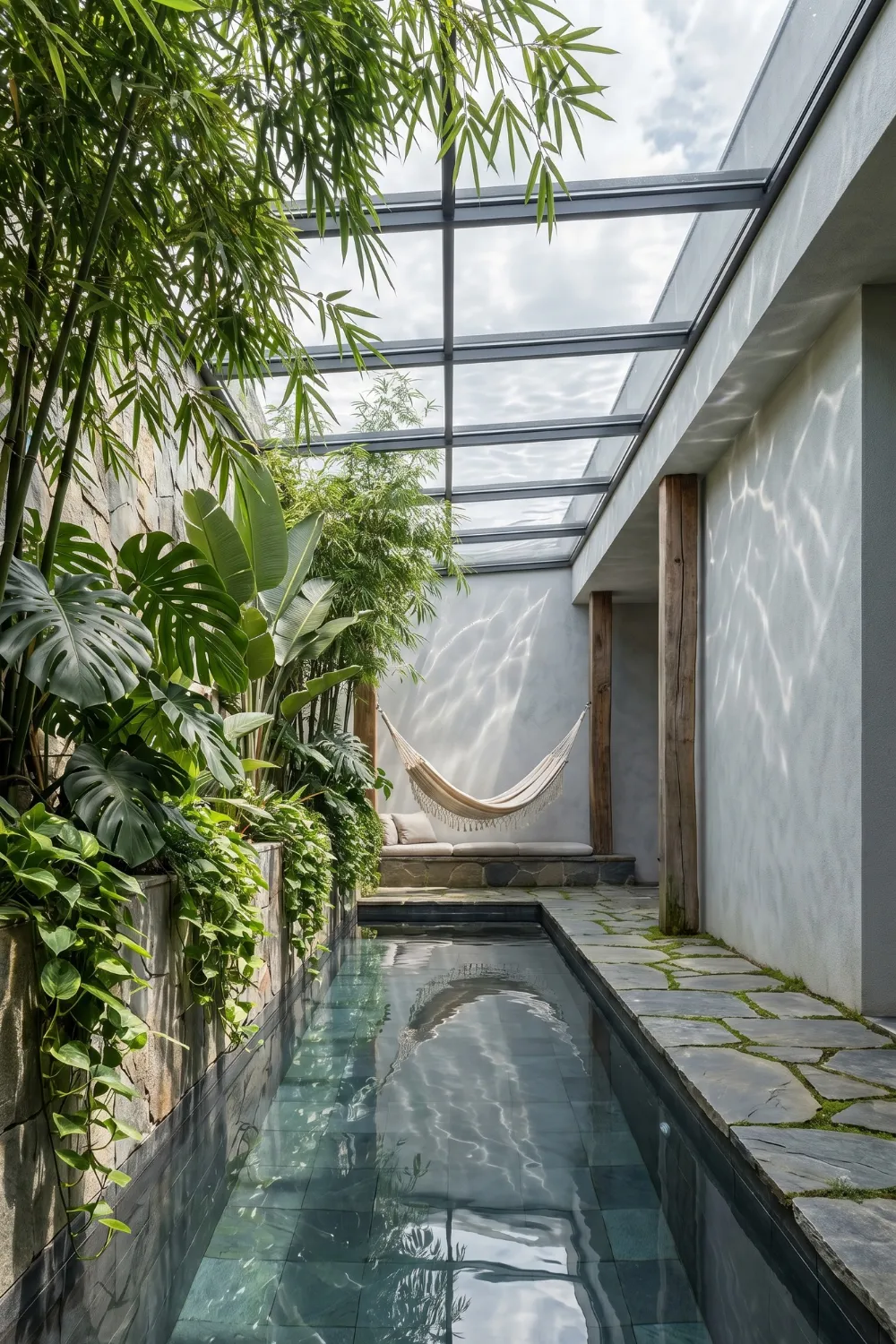
Lap pools get a bad reputation for being purely utilitarian. This one challenges that completely.
The narrow, elongated layout does exactly what it should — it stretches the visual length of the room and creates a satisfying sense of direction and movement. But it’s the glass roof overhead that unlocks the whole concept, flooding the space with natural light that makes the indoor jungle thrive without artificial intervention.
The hammock tucked along one side is the detail I keep coming back to. It’s unexpected. It breaks the rigidity of a narrow lap pool layout with something casual and tactile. Pair that with stone flooring, pebble detailing, and you’ve got a space that feels genuinely curated rather than designed-by-committee.
Plants always look better under natural light. That’s not an opinion — it’s just biology. Skip the harsh artificial spotlights on your indoor greenery. Let the skylights do it instead.
The Statement Green Wall Pool — One Bold Move, Fully Committed
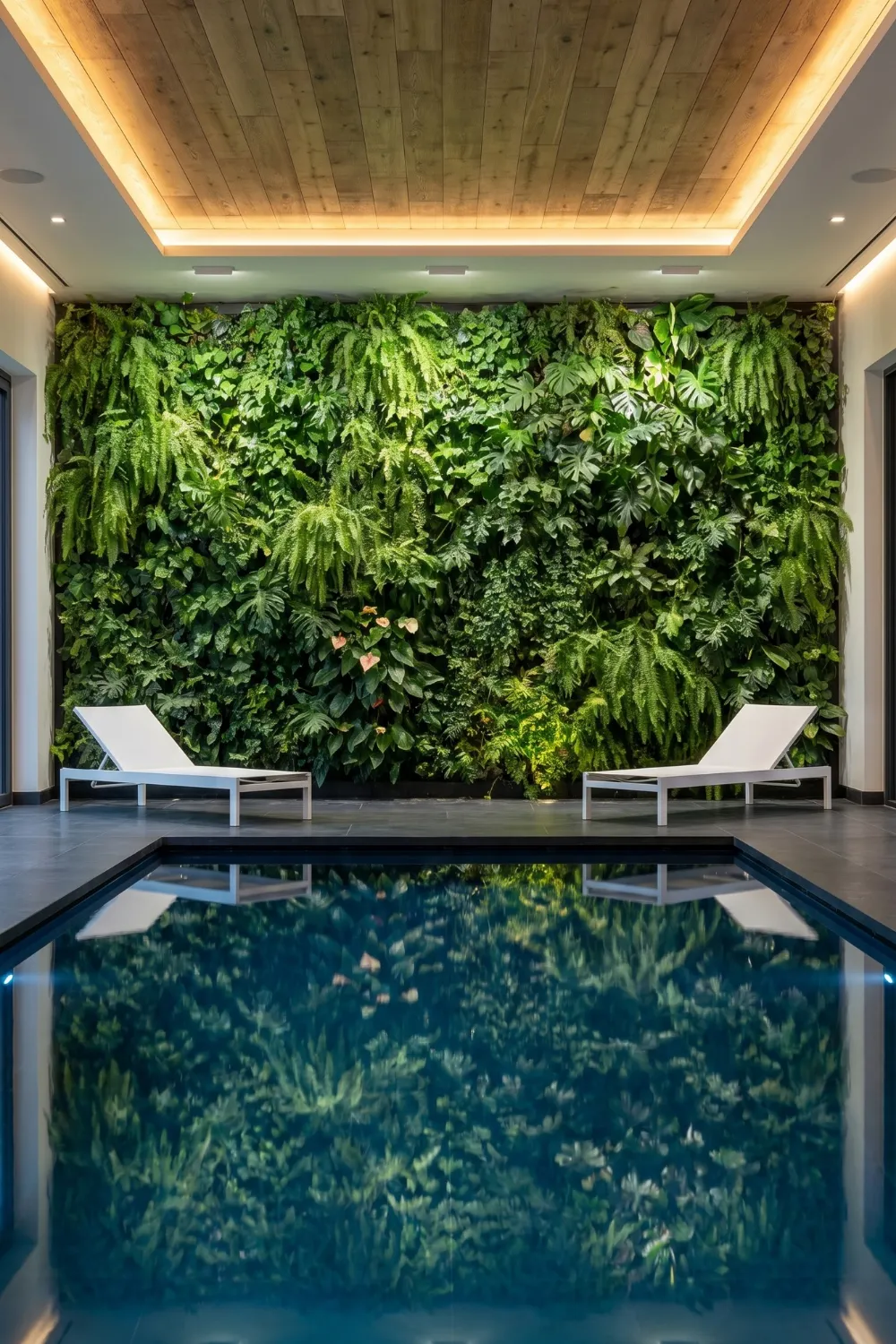
Some rooms try to impress you with everything at once. This one picks one dramatic move and executes it with total confidence: a full vertical green wall at the far end of the pool.
It acts as a natural focal point, pulling your eye straight through the space from the moment you walk in. Every well-designed room has a clear focal point — one thing that anchors the eye and organizes everything else around it. This green wall understood the assignment.
The symmetry throughout the rest of the room is quiet and deliberate. Pool, ceiling beams, and seating are all aligned on the same axis. It creates visual order without feeling rigid. The wood ceiling panels add warmth overhead, and hidden LED strips along the ceiling perimeter cast a soft glow that combines with the water’s light reflections to add a dimension you simply can’t achieve with floor lamps and accent decor.
Don’t ignore your ceiling. It’s the fifth wall, and it’s doing nothing in most pool spaces.
→ More feature wall ideas for interior spaces
The Cozy Cabin Pool — When Intimacy Beats Grandeur
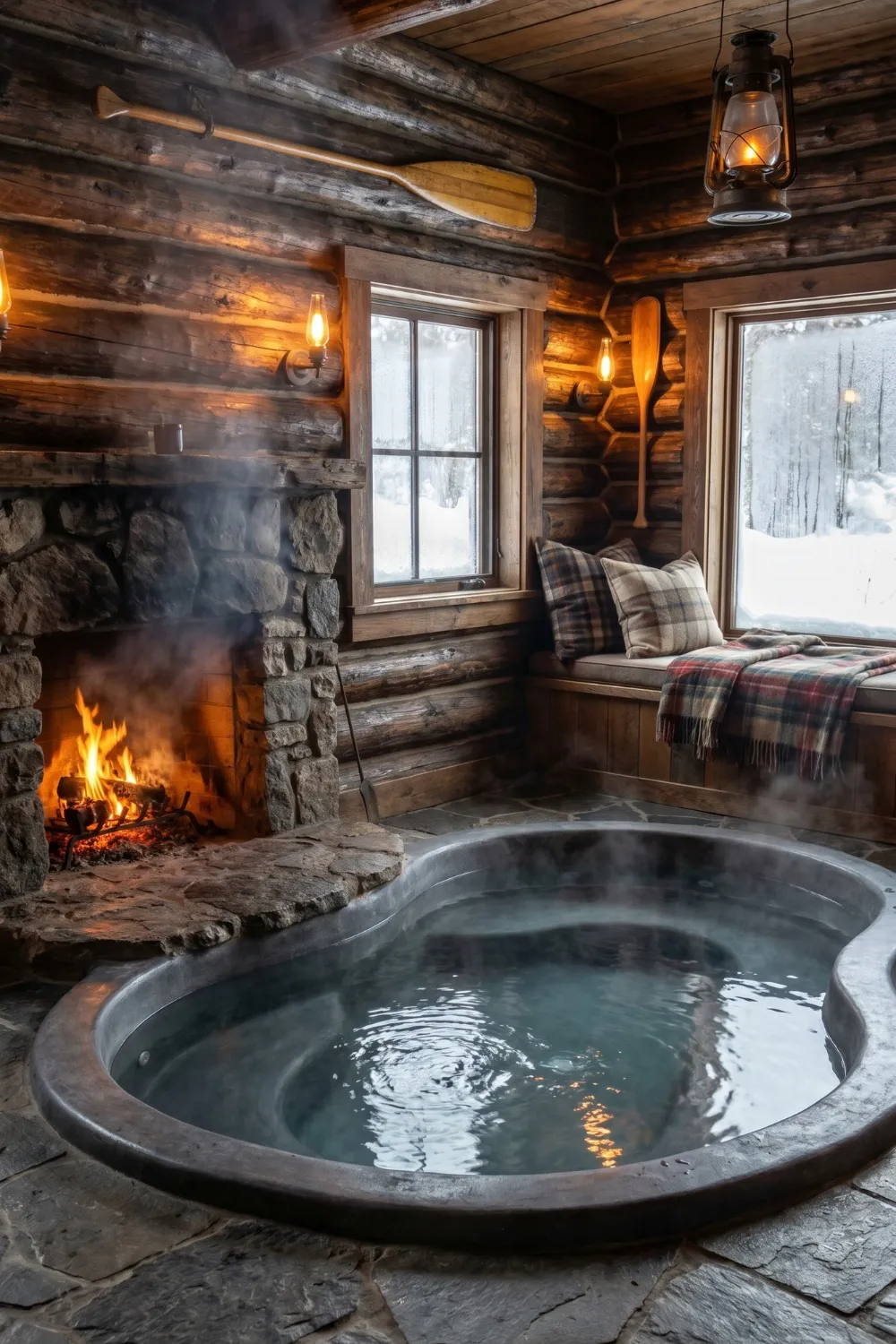
Not every indoor pool needs to feel monumental. And honestly, some of the most inviting ones don’t.
This cabin-style pool is warm, intimate, and unapologetically nostalgic. Rustic beams overhead, worn wood tones throughout, a fireplace tucked right at the pool’s edge. It’s the kind of space that makes you want to stay long after you’ve stopped swimming.
What makes it work is the layering of imperfect textures — stone that looks quarried, wood that looks lived-in, textiles that look used. Slightly imperfect finishes feel more inviting than polished ones. Perfect surfaces are for showrooms. Livable spaces need a little softness.
The seating is placed right at the pool’s edge, which blurs the zone between swimming and lounging in the best possible way. Add throws, cushions in warm tones, and soft lighting. And the whimsical wall details? They make the space memorable. A little personality — even something quirky — is what turns a designed room into a space that feels like it belongs to someone.
The Double-Height Pool With Loft Garden — Thinking Vertically
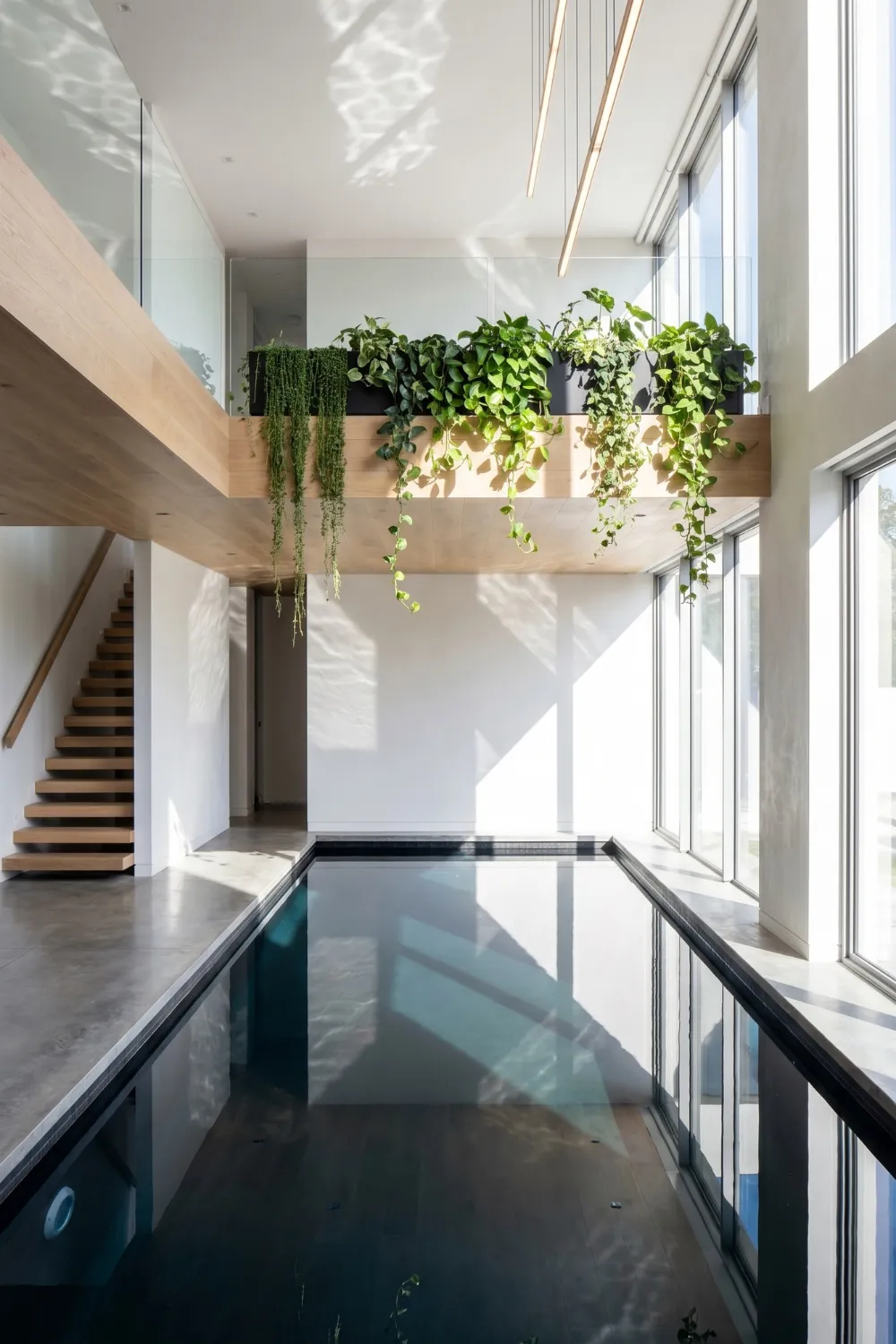
This is what happens when a designer refuses to think in two dimensions.
The double-height ceiling instantly transforms scale — the pool below feels grander, more open, more considered. And the mezzanine level above, planted with greenery that spills over the railing, adds a second layer of visual interest that makes the whole room feel dynamic rather than static.
You don’t need a full mezzanine to borrow this idea. A high shelf lined with trailing plants, hanging planters at different heights, or a lofted reading nook can all introduce that vertical layering in a smaller home. The principle is the same: design upward, not just outward.
Large windows flood the room with light — which is critical in tall spaces. Without enough natural or artificial light, double-height rooms feel empty rather than airy. Keep the palette warm and cohesive (wood, stone, neutral upholstery), and let the height be the drama rather than fighting it with competing decor.
What Ties All of These Spaces Together
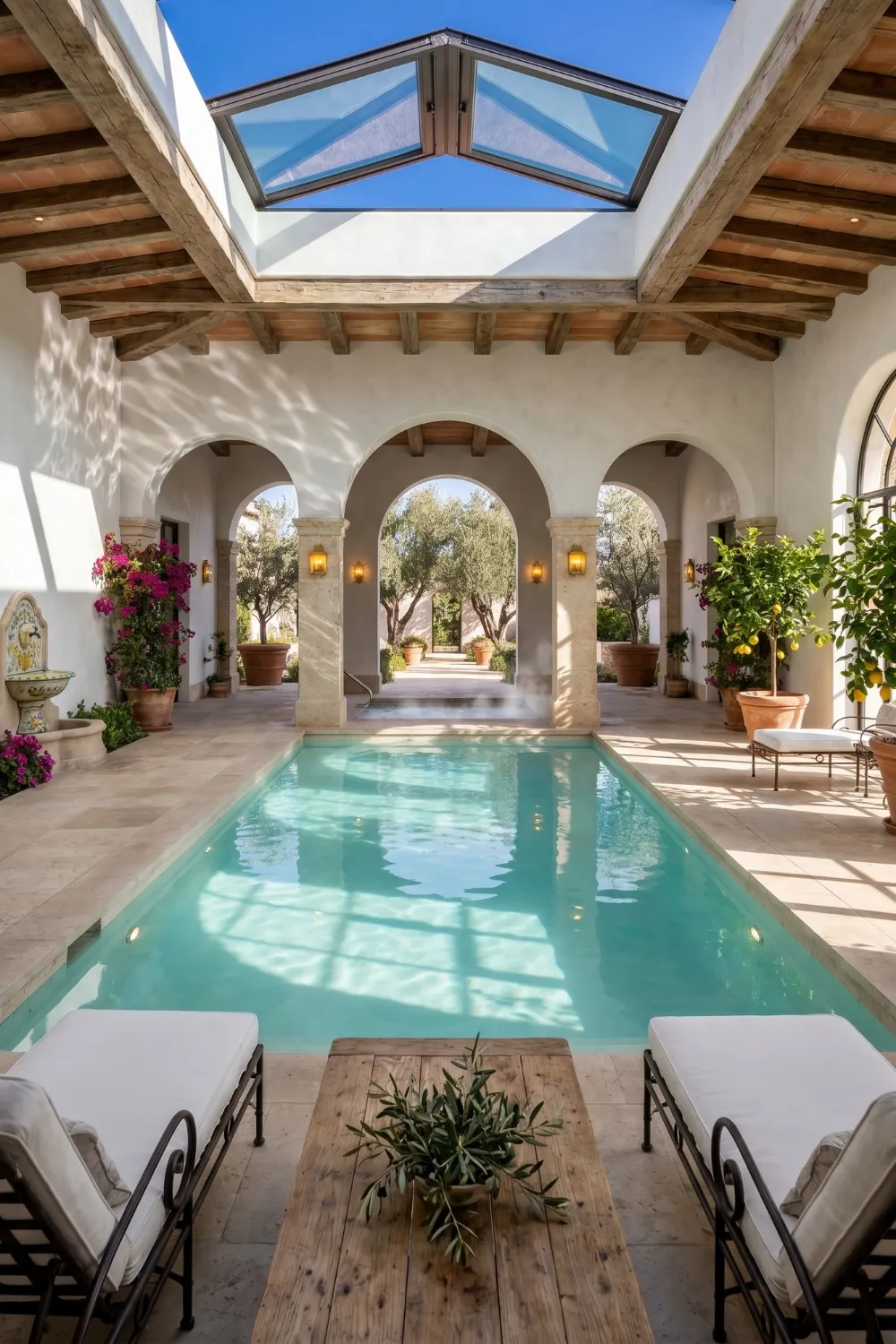
After going through all eleven of these indoor pool concepts, one thing is clear — the most successful spaces aren’t the ones with the biggest budgets. They’re the ones built around a clear design intention.
Consistent material palettes. Thoughtful, layered lighting. A strong focal point. Vertical interest. And always, always some element of personality — whether that’s a waterfall, a fire feature, a hammock, or a wall of tropical plants.
The indoor pool spaces that feel genuinely special are the ones where you forget, even briefly, that you’re still inside your own home. That’s the goal. Not perfection. Not status. Just a space that makes you want to stay.
Build toward that, and you’ll get it right.